Pages

Saturday, December 21, 2019

Efficient and Effective Multilingual eDiscovery Practices Using MT


As outlined in a previous post, the global data explosion is creating new challenges for the legal industry that requires balancing the use of emerging technologies and human resources in optimal ways to handle the data deluge effectively.


The continuing digital communication momentum and the much more rapid pace of globalization today often create specialized legal challenges. The rapid increase in global business interactions, varying regulatory laws, business practices, and cultural customs of international partners and competitors are confounding and often frustrating to participants. The impact of all these concurrent trends is driving the volume of cross-border litigation up, and necessitates that corporate general counsel in global enterprises, and large law firms find the means to perform the critical functions related to manage the unique requirements of legal eDiscovery in these particular scenarios.

A recent Norton Rose Fulbright survey of litigation trends highlights the need for technology to enhance efficiency in legal departments and also points out the growth of cybersecurity and data protection disputes increasing across all industries. Additionally, the survey states that increasingly, international business operations lead to an increase in cross-border discovery and related data protection issues. The survey found that within the life sciences and healthcare and technology and innovation sectors, the most concerning area is IP/Patent disputes. IP/Patent disputes are regarded as relatively costly in comparison to other legal matters, and technology and life sciences companies, in particular, face large exposure in this area.

By understanding the unique discovery requirements of different regions, instilling transparency and consistency throughout the discovery team and process, and taking advantage of powerful technology and workflow tools, companies can be better equipped to meet the discovery demands of litigation and regulatory investigations. The multilingual impact of this data deluge is just now being understood, and as we move to a global reality where the largest companies and markets in the globe are increasingly not English-speaking regions, the ability to handle huge volumes of flowing multilingual data become a way to build competitive advantage, and avoid becoming commercially irrelevant. Being able to handle large volumes of multilingual data effectively is a critical requirement for the modern enterprise.


What is eDiscovery?


Electronic discovery (sometimes known as e-discovery, eDiscovery, or e-Discovery) is the electronic aspect of identifying, collecting and producing electronically stored information (ESI) in response to a request for production in a lawsuit or an internal corporate investigation. ESI includes, but is not limited to, emails, documents, presentations, databases, voicemail, audio and video files, social media content, and websites.

The processes and technologies around eDiscovery are often complex because of the sheer volume/variety of electronic data produced and stored. Additionally, unlike hard-copy evidence, electronic documents are more dynamic and often contain metadata such as time-date stamps, author and recipient information, and file properties. Preserving the original content and metadata for electronically stored information is required to eliminate claims of spoliation or tampering with evidence later in a litigation scenario.

EDiscovery is typically a culling process, of moving from unstructured to structured data – from unstructured data to matter-specific relevance, and the highest value and most directly relevant information.


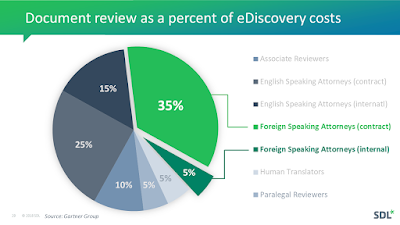
Thus, while there are three primary activities typically in eDiscovery, namely, collection, processing, and review, it is clear to practitioners and analysts that the review-related activity is the bulk of the cost of the overall eDiscovery process.

One analyst estimates that review-related software and services are estimated to constitute approximately 70% of worldwide eDiscovery software and services spending in 2018. While the percentage of spending on the eDiscovery task of review is estimated to decrease to around 65% of overall eDiscovery spending through 2023, the overall spend in dollars for eDiscovery review is estimated to grow to $12.15B by 2023.

A respected RAND Institute study is even more explicit about the costs and shows very clearly that managing your data volume is critical to managing your costs. The Rand Institute for Civil Justice estimates that the per-gigabyte costs break down to $125 to $6,700 for collection, $600 to $6,000 for processing, and, in the most expensive stage, $1,800 to $210,000 for review. The costs for multilingual review are very likely even higher and by some estimates could be as much as 3X times higher.

"The RAND Institute for Civil Justice has estimated that each gigabyte of data reviewed costs a company approximately $18,000."


This means that a conscientious, defensible, proactive approach to information governance can lead to tremendous savings. Every gigabyte of outdated unnecessary ESI that you delete in following a uniform data destruction policy saves you, on average, $18,000 per case.


What is document review?

Also known simply as review, document review is the stage of the EDRM in which organizations examine documents connected to a litigation matter to determine if they are relevant, responsive, or privileged. The value of having robust information governance policies in place makes the overall process both more effective and more efficient. Due to outsourcing and the high cost of using lawyers, document review is the most expensive stage of eDiscovery. It is generally responsible for 70% or more of the total cost of eDiscovery.

The cost per hour for document review attorneys to review documents during the review phase of eDiscovery is one of the most expensive steps in the overall process, something which is only further exacerbated when the attorneys have to be bilingual at a high level of proficiency.


To control those extravagant costs, litigants strive to narrow the field of documents that they must review. The processing stage of eDiscovery is intended in large part to eliminate redundant information and to organize the remaining data for efficient, cost-effective document review. Technology that assists in the culling and close examination process is essential, and we see that eDiscovery platforms that assist professional services, law firms, and information technology organizations to find, store, review and create legal documents are increasingly pervasive.

Document review can be used in more than just legal eDiscovery for litigation. It may also be used in regulatory investigations, internal investigations, and due diligence assessments for mergers and acquisitions and other information governance-related activities. Wherever it is employed, it serves the same purpose of designating information for production and requires a similar approach.

The Multilingual eDiscovery process


It is possible to identify the critical steps involved in a typical multilingual eDiscovery use case where the key objective is to extract the most relevant information form a large volume of submitted material. The multilingual characteristics of much of the data that needs to be reviewed today adds a significant layer of complexity and an additional cost to the process.


The typical process involves the following key steps:
  • Text Extraction: It is often necessary to extract multilingual text from scanned documents to ensure that all relevant documents are identified and sent to review.  OCR technology and native file processing technology to enable an enterprise to do this at scale. Sometimes it is also required to extract text from audio. 
  • Automated Language Identification Processing:  Linguistic AI technology capabilities make automatic detection of languages and data sets within any content an efficient and highly automated process.
  • Multilingual Search Term Optimization: Linguists work together with MT experts to generate critical search and terminology to ensure that multilingual data goes through optimal discovery related processing. This ensures that high volume automatic translations get critical terminology correct, and also enables the most relevant foreign language data to be discovered and presented for timely review. The multilingual search term consultant’s understanding of linguistic and cultural nuances can mean the difference between capturing critical information and missing it completely. Competent linguists ensure that grammatical, linguistic and cultural issues are taken into consideration during search term list development.
  • Secure, Private, State-of-the-Art Machine Translation: Firms should work and develop secure, private, scalable enterprise-ready MT technology that can be deployed on-premise or in the private cloud. Integration with Relativity (and other eDiscovery platforms) makes it easy for companies to handle anything related to large corporate legal matters, from analyzing and translating millions of documents to preparing critical contracts and court-presentable documents.
  • Specialized Human Translation Services: Many firms provides around-the-clock, around-the-world service using state-of-the-art linguistic AI tools to ensure greater accuracy, security reduced costs and turnaround time. The company has a pool of certified and specialized translators across multiple jurisdictions and languages worldwide who have expertise and competence across a wide range of legal documents. The company is already working with 19 of the top 20 law firms in the world. The translation supply chain is often the hidden weak spot in an organization's data compliance. Several firms provide a secure translation supply chain that gives you fully auditable, data custody of your translation processes and can be cascaded down through your outside counsel and consultants to create a replicable process across all of your legal service partners.


This is a post that was originally published on SDL.COM with more detail on SDL products  


Thursday, November 7, 2019

The Global Data Explosion in the Legal Industry

As we consider and look at the various forces impacting the legal industry today, we see several ongoing trends which are increasingly demanding more attention from both inside and outside counsel. These forces are:
  • The Digital Data Momentum
  • Increasing Concern for Data Security
  • The Growing Importance of Information Governance
  • Increasing Globalization 


The Digital Data Momentum


Several studies by IDC, EMC and academics have predicted for years that we are facing an ever-growing data deluge and content explosion. The prediction that the digital universe will be 44 zettabytes by 2020 means little to most of us. But if you state that 500 million tweets, ~300 billion emails, 65 billion Whatsapp messages are sent, and 3.5 billion Google searches are made every single day, many more of us would understand the astounding scale of the modern digital world. While only a small fraction of this data will flow into the purview of the legal profession, the impact is significant and most legal teams will admit this increase in content is a major challenge today.


The enterprise is also affected by this content explosion, and a recent eDiscovery Business Confidence survey identified increasing data volumes as THE primary concern for the coming future. In eDiscovery settings, this also means that the information triage process is complicated since we are seeing not only significant increases in volume, but we are also seeing a greater variety of data types. The modern legal purview can include mobile data, voice and image data from various sources in addition to the data flowing in various enterprise IT systems. 

 Increasing Concern for Data Security


While data security has not been a concern in the past, it is increasingly being seen as a key concern. At recent Davos conferences, cybersecurity and data privacy breakdowns are seen as the biggest threats to businesses, economies, and societies around the world. According to the World Economic Forum (WEF), attacks against businesses have almost doubled in five years and the costs are rising too. “The world depends on digital infrastructure and people depend on their digital devices and what we’ve found is that these digital devices are under attack every single day,” said Brad Smith, president, and chief legal officer, Microsoft. He added that attacks by organized criminal enterprises are becoming “more prolific and more sophisticated”, often “operating in jurisdictions that are more difficult to reach through the rule of law but use the internet to seek out victims literally everywhere.”

This rise of artificial intelligence and machine learning also means that global enterprises are interested in acquiring and harvesting data, wherever and whenever they can. Businesses are looking to acquire as much information as possible, about customers, interactions, brand opinions, and extracting insights that might give them an edge over the competition. Data-guzzling machine learning processes promise to amplify businesses’ ability to predict, personalize, and produce. However, some of the world’s largest consumer-facing companies have fallen victim to data breaches affecting hundreds of millions of customers. By all measures, the disruptive, data-centric forces of the so-called fourth industrial revolution appear to be outpacing the world’s ability to control them.

Legal professionals will need to play a larger role in managing these new risks, which can be devastating and cost millions in reparations and negative consequences.  Increasingly these threats originate in foreign countries and sometimes even with support from foreign governments

 Internal Investigations


The Growing Importance of Information Governance


The modern global enterprise has a very different risk tolerance profile from similar companies, even as recently as 10 years ago. The “datafication” of the modern enterprise creates special challenges for both inside and outside counsel.  Recent surveys by Gartner suggest that legal leaders have to start investing in digital skills and capabilities, reflecting the evolving role of the legal department as a strategic business partner.

“How legal departments build capabilities to govern risk within digital initiatives matter more than the legal advice they provide” says Christina Hertzler, Practice Vice President, Gartner.

To be digitally ready, legal departments must shift their approach to manage specific changes created by digitalization — more stakeholders, more speed and iteration, and the increased technical and collaborative nature of digital work, as well as handling new information-related risks.

As organizations change the way they operate, generate revenue and create value for their customers, new compliance risks are emerging — presenting a challenge to compliance, which must identify, assess and mitigate risks like those tied to fundamentally new technologies (e.g., artificial intelligence) and processes.

Information Governance

There is a growing list of US companies already subjected to GDPR-related EU regulatory actions, including, Amazon, Apple, Facebook, Google, Netflix, Spotify, and Twitter. Indeed, the French Data Protection Authority, CNIL, recently levied upon Google a record fine of approximately $57 million dollars for “lack of transparency, inadequate information and lack of valid consent regarding ads personalization.” The risks to US companies include providing proof of measures taken to protect, process, and transfer personal data from the EU to the US in connection with regulatory investigations or litigation.  A report published in late February by DLA Piper cited data from the first eight months of GDPR enforcement, during which 91 fines were imposed. "We expect that 2019 will see more fines for tens and potentially even hundreds of millions of euros, as regulators deal with the backlog of GDPR data breach notifications," the report said. Taking meaningful steps now toward GDPR compliance is the best way for US companies doing business of any kind involving EU personal data—including those with no physical presence in the EU—to prepare for and mitigate their risk.

The penalties of non-compliance with regulatory policies continue to mount.  Google was fined $170 million and asked to make changes to protect children’s privacy on YouTube, as regulators said the video site had knowingly and illegally harvested personal information from children and used it to profit by targeting them with ads. We can only expect that data privacy and compliance regulations will be taken more seriously in the future and that legal teams will play an expanding role in ensuring this.

Facebook agreed to pay a record-breaking $5 billion fine as part of a settlement with the Federal Trade Commission, by far the largest penalty ever imposed on a company for violating consumers' privacy rights. Facebook also agreed to adopt new protections for the data users share on the social network and to measures that limit the power of CEO Mark Zuckerberg. Under the settlement, which concludes a year-long investigation prompted by the 2018 Cambridge Analytica scandal, the social networking giant must expand its privacy protections across Facebook itself, as well as on Instagram and WhatsApp. It must also adopt a corporate system of checks and balances to remain compliant, according to the FTC order. Facebook must also maintain a data security program, which includes protections of information such as users' phone numbers. The issue of data privacy and compliance will continue to build momentum as more people understand the extent of the data harvesting that is going on.

Taking meaningful steps now toward robust information governance and compliance for all kinds of privileged and confidential data will be necessary for the modern digital-centric enterprise, and the modern legal department will need to be able to be an active partner and help the enterprise prepare for and mitigate their risk.


Compliance and Regulation Processes


Increasing Globalization = More Multilingual Data


While these forces we have just described continue to build momentum, driven by increasing digitalization and the resultant ever expanding content flows, we also have an additional layer of complexity: language. The modern enterprise is now much more rapidly and naturally global, and thus now the modern legal department and outside counsel need to be able to process content and information flows in multiple languages on a regular basis. The variety and volumes of multilingual content that legal professionals need to process and monitor can include any and all of the following:
  • International contract negotiations and disputes
  • Patent-infringement litigation
  • Human Resource communications in global enterprises
  • Customer communications
  • GDPR Compliance related monitoring and analysis 
  • Cross-border regulatory compliance monitoring
  • FCPA compliance monitoring 
  • Anti-trust related matters
The volumes of multilingual content can vary greatly, from very large volumes that might involve tens of thousands of documents in litigation related eDiscovery, to specialized monitoring of customer communications to ensure regulatory compliance, to smaller volumes of sensitive communications with global employees.

Multilingual issues are especially present in cross-border partnerships and business dealings which are now increasingly common across many industries.
The AlixPartners Global Anticorruption Survey polled corporate counsel, legal, and compliance officers at companies based in the US, Europe, and Asia in more than 20 major industries. The perceived corruption risks are elevated in Latin America and China, and Russia, Africa, and the Middle East have emerged as regions of increasing concern. The survey found that 90% and 94% of companies with operations in Latin America and China, respectively, reported their industries are exposed to corruption risk. Of the 66% of respondents who said there are regions where it is impossible to avoid corrupt business practices, 31% said Russia is one such place and 27% cited Africa.

The sheer volume of information companies must collect, translate, and analyze is the biggest obstacle to tackling corruption, according to 75% of survey respondents. 

These concerns surrounding the management of data are expected to increase with increasing data privacy regulation such as the EU’s General Data Protection Regulation.

 Data Growth


End-to-end translation solutions for the legal industry 


Thus, we see today that language translation production capabilities have become imperative for the modern global enterprise and that the needs for translation can range from rapid translation of millions of documents in an eDiscovery scenario to very careful and specialized translation of critical contract and court-ready documentation. Given the volume, variety, and velocity of the information that needs translation, legal professionals must consider a combination of technology and human services. Ideally, solving these kinds of varying translation challenges would be done by technologically informed professionals who solve complex and varied translation problems and who can adapt language technology and human expertise to the challenge at hand. 

Language Translation


Several MT and language service vendors provide an enterprise-class, vendor agnostic, secure translation platform that allows you to combine regulatory compliance and translation best practice. Securing the translation supply chain needn’t come at the cost of trusted suppliers, existing relationships or impact time to market.

Multilingual Data Triage


This blog was originally published on SDL.COM with more SDL product information.

Tuesday, October 8, 2019

Post-editese is real

Ever since machine translation was introduced into the professional translation industry, there have been questions about what the impact would be on a final delivered translation service product. For much of the history of MT many translators claimed that while translation production work using a post-edited MT (PEMT) process was faster, the final product was not as good. The research suggests that this has been true from a strictly linguistic perspective, but many of us also know that PEMT worked quite successfully with technical content especially with terminology and consistency even in the days of SMT and RBMT. 

As NMT systems proliferate, we are at a turning point, and I suspect that we will see many more NMT systems that are in fact seen as providing useful output that clearly enhances translator productivity, especially on output from systems built by experts. NMT will also quite likely have an influence on the output quality and the difference is also likely to become less prominent. This is what is meant by developers who make claims of achieving human parity. If competent human translators cannot tell that segments they review came from MT or not, we can make a limited claim of having achieved human parity. This does not mean that this will be true for every new sentence submitted to this system. 

We should also understand that MT  provides the greatest value in use scenarios where you have large volumes of content (millions rather than thousands of words), short turnaround times, and limited budgets. Increasingly MT is used in scenarios where little or no post-editing is done, and by many informed estimates, we are already at a run rate of a trillion words a day going through MT engines. While post-editese may be an important consideration in localization use scenarios, this is likely no more than 2% of all MT usage.  

Enterprise MT use is rapidly moving into a phase where it is an enterprise-level IT resource. The modern global enterprise needs to enable and allow millions of words to be translated on demand in a secure and private way and needs to be integrated deeply into critical communication, collaboration, and content creation and management software.

The research presented by Antonio Toral below documents the impact of post-editing on the final output across multiple different language combinations and MT systems. 


==============

This is a summary of the paper “Post-editese: an Exacerbated Translationese” by Antonio Toral, which was presented at MT Summit 2019, where it won the best paper award.


Introduction


Post-editing (PE) is widely used in the translation industry, mainly because it leads to higher productivity than unaided human translation (HT). But, what about the resulting translation? Are PE translations as good as HT? Several research studies have looked at this in the past decade and there seems to be consensus: PE is as good as HT or even better (Koponen, 2016).

Most of these studies measure the quality of translations by counting the number of errors therein. Taking into account that there is more to quality than just the number of mistakes, we ask ourselves the following question instead: are there differences between translations produced with PE vs HT? In other words, does the final output created via PEs and HTs have different traits?

Previous studies have unveiled the existence of translationese, i.e. the fact that HTs and original texts exhibit different characteristics. These characteristics can be grouped along with the so-called translation universals (Baker, 1993) and fundamental laws of translation (Toury, 2012), namely simplification, normalization, explicitation and interference. Along this line of thinking, we aim to unveil the existence of post-editese (i.e. the fact that PEs and HTs exhibit different characteristics) by confronting PEs and HTs using a set of computational analyses that align to the aforementioned translation universals and laws of translation.

Data

We use three datasets in our experiments: Taraxü (Avramidis et al., 2014), IWSLT (Cettolo et al., 2015; Mauro et al., 2016) and Microsoft “Human Parity” (Hassan et al., 2018). These datasets cover five different translation directions and allow us to assess the effect of machine translation (MT) systems from 2011, 2015-16 and 2018 on the resulting PEs.

Analyses

Lexical Variety

We assess the lexical variety of a translation (HT, PE or MT) by calculating its type-token ratio:

In other words, given two translations equally long (number of words), the one with bigger vocabulary (higher number of unique words) would have a higher TTR, being therefore considered lexical richer, or higher in lexical variety.

The following figure shows the results for the Microsoft dataset for the direction Chinese-to-English (zh–en, the results for the other datasets follow similar trends and can be found in the paper). HT has the highest lexical variety, followed by PE, while the lowest value is obtained by the MT systems. A possible interpretation is as follows: (i) lexical variety is low in MT because these systems prefer the translation solutions that are frequent in the training data used to train such systems and (ii) a post-editor will add lexical variety to some degree (difference in the figure between MT and PE), but because MT primes him/her (Green et al., 2013), the resulting PE translation will not achieve the lexical variety of HT.


Lexical Density

The lexical density of a text indicates its amount of information and is calculated as follows:
where content words correspond to adverbs, adjectives, nouns, and verbs. Hence, given two translations equally long, the one with the higher number of content words would be considered to have higher lexical density, in other words, to contain more information.

The following figure shows the results for the three translation directions in the Taraxü dataset: English-to-German, German-to-English and Spanish-to-German. The lexical density in HT is higher than in both PE and MT and there is no systematic difference between the latter two.

Length Ratio

Given a source text (ST) and a target text (TT), where TT is a translation of ST (HT, PE or MT), we compute a measure of how different in length the TT is with respect to the ST:
This means that the bigger the difference in length between the ST and the TT (be it because TT is shorter or longer than the ST), the higher the length ratio.

The following figure shows the results for the Taraxü dataset. The trend is similar to the one in lexical variety; this is, HT obtains the highest result, MT the lowest and PE lies somewhere in between. We interpret this as follows: (i) MT results in a translation of similar length to that of the ST due to how the underlying MT technology works and PE is primed by the MT output while (ii) a translator working from scratch may translate more freely in terms of length.

Part-of-speech Sequences

Finally, we assess the interference of the source language on a translation (HT, PE and MT) by measuring how close the sequence of part-of-speech tags in the translation is to the typical part-of-speech sequences of the source language and to the typical part-of-speech sequences of the target language. If the sequences of a translation are similar to the typical sequences of the source language that would indicate that there is an inference from the source language in the translation.

The following figure shows the results for the IWSLT dataset. The metric used is perplexity difference; the higher it is the lower the interference (full details on the metric can be found in the paper). Again, we find a similar trend as in some of the previous analyses: HT gets the highest results, MT the lowest and PE somewhere in between. The interpretation is again similar: MT outputs exhibit a large amount of interference from the source language, a post-editor gets rid of some of that interference but the resulting translation still has more interference than an unaided translation.


Findings

The findings from our analyses can be summarised as follows in terms of HT vs PE:
  • PEs have lower lexical variety and lower lexical density than HTs. We link these to the simplification principle of translationese. Thus, these results indicate that post-editese is lexically simpler than translationese.
  • Sentence length in PEs is more similar to the sentence length of the source texts, than sentence length in HTs. We link this finding to interference and normalization: (i) PEs have
interference from the source text in terms of length, which leads to translations that follow the typical sentence length of the source language; (ii) this results in a target text whose
length tends to become normalized.
  • Part-of-speech (PoS) sequences in PEs are more similar to the typical PoS sequences of the source language than PoS sequences in HTs. We link this to the interference principle: the sequences of grammatical units in PEs preserve to some extent the sequences that are typical of the source language.

In terms of the role of MT: we have not considered only HTs and PEs but also MT outputs, from the MT systems that were the starting point to produce the PEs. This to corroborate a claim in the literature (Greenet al., 2013), namely that in PE the translator is primed by the MT output. We expected then to find similar trends to those found in PEs also in MT outputs and this was indeed the case in all four analyses. In some experiments, the results of PE were somewhere in between those of HT and MT. Our interpretation is that a post-editor improves the initial MT output, but due to being primed by the MT output, the result cannot attain the level of HT, and the footprint of the MT system remains in the resulting PE.

Discussion

As said in the introduction, we know that PE is faster than HT. The question I wanted to address was then: can PE not only be faster but also be at the level of HT quality-wise? In this study, this is looked at from the point of view of translation universals and the answer is clear: no. However, I'd like to point out three additional elements:
  1. The text types in the 3 datasets that I have used are news and subtitles, both are open-domain and could be considered to a certain extent "creative". I wonder what happens with technical texts, given their relevance for industry, and I plan to look at that in the future.
  2. As mentioned in the introduction, previous studies have compared HT vs PE in terms of the number of errors in the resulting translation. In all the studies I've encountered PE is at the level of HT or even better. Thus, for technical texts where terminology and consistency are important, PE is probably better than HT. I find thus the choice between PE and HT to be a trade-off between consistency on one hand and translation universals (simplification, normalization and interference) on the other.
  3. PE falls behind HT in terms of translation universals because MT falls behind HT in those terms. However, this may not be the case anymore in the future. For example, the paper shows that PE-NMT has less interference than PE-SMT, thanks to the better reordering in the former.


Antonio Toral is an Assistant Professor at the Computational Linguistics group, Center for Language and Cognition, Faculty of Arts, University of Groningen (The Netherlands). His research is in the area of Machine Translation. His main topics include resource acquisition, domain adaptation, diagnostic evaluation and hybrid approaches.


Related Work

Other work has previously looked at HT vs PE beyond the number of errors. The most related papers to this paper are Bangalore et al. (2015), Carl and Schaeffer (2017), Czulo and Nitzke (2016), Daems et al. (2017) and Farrell (2018).

Bibliography


Avramidis, Eleftherios, Aljoscha Burchardt, Sabine Hunsicker, Maja Popovic, Cindy Tscherwinka, David Vilar, and Hans Uszkoreit. 2014. The taraxü corpus of human-annotated machine translations. In LREC, pages 2679–2682.

Baker, Mona. 1993. Corpus linguistics and translation studies: Implications and applications. Text and technology: In honor of John Sinclair, 233:250.

Bangalore, Srinivas, Bergljot Behrens, Michael Carl, Maheshwar Gankhot, Arndt Heilmann, Jean Nitzke, Moritz Schaeffer, and Annegret Sturm. 2015. The role of syntactic variation in translation and post-editing. Translation Spaces, 4(1):119–144.

Carl, Michael and Moritz Jonas Schaeffer. 2017. Why translation is difficult: A corpus-based study of non-literality in post-editing and from-scratch translation. Hermes, 56:43–57.

Cettolo, Mauro, Jan Niehues, Sebastian Stüker, Luisa Bentivogli, Roldano Cattoni, and Marcello Federico. 2015. The iwslt 2015 evaluation campaign. In IWSLT 2015, International Workshop on Spoken Language Translation.

Green, Spence, Jeffrey Heer, and Christopher D Manning. 2013. The efficacy of human post-editing for language translation. Chi 2013, pages 439–448.

Hassan, Hany, Anthony Aue, Chang Chen, Vishal Chowdhary, Jonathan Clark, Christian Federmann, Xuedong Huang, Marcin Junczys-Dowmunt, Will Lewis, Mu Li, Shujie Liu, Tie-Yan Liu, Renqian Luo, Arul Menezes, Tao Qin, Frank Seide, Xu Tan, Fei Tian, Lijun Wu, Zhuangzi Wu, Yingce Xia, Dongdong Zhang, Zhirui Zhang, and Ming Zhou. 2018. Achieving Human Parity on Automatic Chinese to English News Translation. https://arxiv.org/abs/1803.05567.

Koponen, Maarit. 2016. Is machine translation post-editing worth the effort? A survey of research into post-editing and effort. Journal of Specialised Translation, 25(25):131–148.

Mauro, Cettolo, Niehues Jan, Stüker Sebastian, Bentivogli Luisa, Cattoni Roldano, and Federico Marcello. 2016. The iwslt 2016 evaluation campaign. In International Workshop on Spoken Language Translation.

Toury, Gideon. 2012. Descriptive translation studies and beyond: Revised edition, volume 100. John Benjamins Publishing.