Pages

Showing posts with label Translation Industry. Show all posts

Wednesday, April 16, 2025

A View from the GALA 2025 Conference

These are uncertain times for many in the language services and localization industry. There was a palpable air of concern and angst in Montreal. This is to be expected given all the changes that we face from so many directions:  

  • ·         Disruption of established government and trade policies
  • ·         AI hype in general is threatening many white-collar jobs
  • ·         Unrealizable expectations about the potential capabilities of AI technology from C-suite leaders that cannot be delivered
  • ·         An emerging global economic slowdown after an already tough business year
  • ·         High levels of economic and business uncertainty

 The day after the conference, I saw the following in my inbox from CSA Research:


I also saw an announcement for an upcoming webinar from Women In Localization with the theme: Maintaining motivation during disruption, which added the byline, "with constant change, staying motivated can be hard."  There is concern in the industry far beyond the community present at GALA.

However, the keynote presentation by Daniel Lamarre, CEO of the Cirque du Soleil Entertainment Group, provided a memorable, uplifting, and inspiring message to the attendees. I rate it as one of the best, if not THE best, keynotes in all the years I have been attending localization conferences. His message was relevant, authentic, and realistically optimistic while speaking to the heart.

He is uniquely qualified to speak to a doomy, gloomy audience, as he also faces challenges and has risen from what seemed insurmountable odds. In response to pandemic shutdowns in March 2020, Cirque du Soleil suspended all 44 active shows worldwide and temporarily laid off 4,679 employees, 95% of its workforce. Annualized revenue dropped from over $1 billion to zero almost overnight. And today, Cirque has to work to remain relevant to digitally obsessed world where many youth have never experienced a circus.

He engineered a recovery, and by early 2023/2024, revenue had climbed back to the pre-pandemic level of approximately $1 billion, though growth is expected to moderate around this level for the next couple of years. Leadership stated the recovery exceeded expectations according to financial market observers.


For someone whose primary focus is to find outstanding artists from around the world, provide them with a regular living, and curate entertainment that leaves the audience enthralled and inspired, he had a clear understanding of the challenges that business translation professionals might have in this age of AI madness.  Somewhat similar to what his organization faced during the pandemic, when the possibility of large audiences congregating to watch a magical musical circus-like performance in 45 cities across the world was an impossibility.

The heart of his message was about building the right mindset as we face challenges, to break through, which he said begins with continual investment in research and development and a strong focus on creativity. This is very much the ethos of Cirque and pervades their overall approach and culture. A summarized highlight of his message follows:

  • ·         Creativity is foundational since it leads to innovation which in turn often results in market leadership.
  • ·         Ongoing and regular reflection is essential to building creativity. 


  • ·         Deep curiosity and the questions that it generates are a building block to discovering successful outcomes.
  • ·         While it is important to focus on the problem to get a clear definition of the challenge, it is even more important to focus creatively on possible solutions.
  • ·         Investment in research and development (e.g., AI impact on translation-related processes) and organizational creativity is essential to finding your value-add in challenging times.
  • ·         Debate is a foundation of evolutionary creativity, and a culture that encourages debate is most likely to find the best outcomes and the best ideas that are not possible with hierarchical mandates.
  • ·         Finding a purpose is more likely to create successful outcomes than goals and objectives.
  • ·         The best ideas will come from a clear mandate, debate, and a defined sandbox rather than through unstructured, frequent meetings with rambling, unfocused discussions.
  • ·         He encouraged the audience to focus much more on communicating the value-add of the business.

I’m not sure I have captured the essence effectively, and as they say, “you had to be there,” as he was successful in lifting everyone’s spirits. His ability to build connections and empathy was indeed unique. He closed by encouraging the GALA community to make more concerted and active efforts to raise their profile and communicate LSP/localization value creation characteristics in the marketplace aggressively, given the unrelenting AI hype.


Raising the LSP Industry Profile

This keynote triggered a recurring theme that attendees raised across several sessions about finding a better way to describe the value of service/product offerings to the marketplace. There were different opinions and views on whether translation, localization, langops, or something else would be the most effective professional self-descriptor to build a value-oriented communication message.

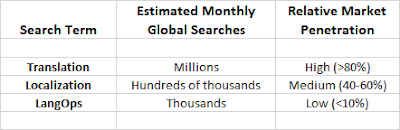
I decided to do some basic research on this subject, via LLM, and I have mixed feelings about the utility of the output, as it lacks insight and understanding. I summarize the unedited responses from 3 different LLM models (which all had very similar results) below:


GPT 4.1 Summary  

Normalized Google Trends Frequency (2022-2025)


Avg Absolute Monthly Search Volume

Normalized Monthly Searches

0-100 Scale 3-Year Mean

Translation

1,000,000

79.9

Localization

200,000

40.1

LangOps

2,000

5.2


Which term provides the greatest reach?

  • Translation is by far the most recognized and searched term globally. It is used by major platforms like Google, DeepL, and Microsoft for their consumer-facing services, which reinforces its dominance and public familiarity.
  • Localization is important for industry professionals and clients needing cultural adaptation and more sophisticated services, but it has a narrower audience.
  • LangOps is emerging in industry circles as a concept for scalable, AI-driven language operations, but its search volume and public awareness remain very low.

Key Points:

  • If your goal is maximum visibility and broad customer acquisition, “translation” is the most effective term. It captures the widest audience, aligns with consumer expectations, and is the default for everyday users seeking language services.
  • “Localization” is valuable for targeting clients who require cultural adaptation and market-specific solutions, but it should be used as a supporting term rather than the primary one.
  • “LangOps” is best reserved for thought leadership, technical blogs, or when targeting enterprise clients already familiar with advanced localization operations.

“Translation” is the term with the greatest and widest reach for LSPs seeking to increase visibility and attract a broad customer base. It is the industry standard, the most searched, and the most recognized by both consumers and businesses. Using “translation” as your primary keyword will maximize your discoverability and support value-driven messaging for the widest possible audience.


Claude Sonnet 3.7 Summary  

Search Term Frequency Analysis

The Google Trends data shows significant differences in search interest across the three terms. "Translation consistently maintains the highest search interest, with values ranging from approximately 80-85 on the relative search interest scale (0-100). "Localization shows moderate interest, with values between 30 and 35, while LangOps demonstrates minimal interest, with values hovering around 2-3.

Translation

"Translation" consistently dominates the search landscape with approximately 2.5 times more search interest than "localization" and about 40 times more interest than "LangOps." This term has maintained its strong position throughout the three years with a slight upward trend.

Localization

"Localization" maintains a consistent moderate interest level, showing some fluctuation but generally staying within the 30-35 range on Google's scale. While significantly lower than "translation," it still demonstrates substantial search volume that has remained stable over the three years.

LangOps

"LangOps" shows minimal search interest, consistently remaining below 5 on Google's scale. Despite being positioned as "the future of scalable, efficient, AI-powered localization" and "the next evolution of localization," it has not gained significant traction in search behavior.


Building Value-Oriented Messaging

To build strong value-oriented messaging:

1.      Lead with "translation" in primary marketing materials, website headers, and SEO strategy to maximize visibility and reach.

2.      Differentiate through "localization" by explaining how your services go beyond basic translation to include cultural adaptation, which adds significant value.

3.      Introduce "LangOps" as an advanced concept for enterprise clients, positioning it as the strategic integration of language services into business operations.

4.      Bridge the terminology gap by explaining how translation evolves into localization and ultimately into LangOps as part of a maturity model for global businesses.


Perplexity Pro Summary  

This output is essentially the same as the data already provided above, as it probably draws its answers from these models. However, this summary seems to be more accommodating of the potential of LangOps, quite possibly because of the extensive use of the term AI in its descriptive materials. They also analyzed each term and its implications in more detail.

Strategic Term Selection for LSPs
Which Term Provides the Greatest Reach?

For an LSP seeking to increase visibility and reach a broader customer base, the choice of terminology is strategically important:

Translation: Maximum Reach, Minimum Differentiation

"Translation" would provide the widest potential reach due to its universal recognition. It's the term used by major platforms like Google, DeepL, and Microsoft[query], indicating its mainstream appeal.

Advantages:

  • Highest search volume and recognition
  • Understood by both technical and non-technical audiences
  • Already associated with established tools and services

Disadvantages:

  • Highly competitive space
  • May position services as commoditized
  • Doesn't communicate advanced capabilities beyond basic translation

Localization: Balanced Reach with Differentiation

"Localization" represents a middle ground, with growing recognition and the ability to communicate more sophisticated services.

Advantages:

  • Communicates a more comprehensive approach than basic translation
  • Established industry term with growing recognition
  • o   Aligns with current industry trends for 2025
  • Suggests cultural adaptation and market-specific expertise

Disadvantages:

  • Lower search volume than "translation"
  • May not capture the attention of clients seeking basic translation services

LangOps: Niche Appeal with Maximum Differentiation

"LangOps" offers cutting-edge positioning but with significantly limited reach.

Advantages:

  • Positions the company at the forefront of industry evolution
  • Communicates AI integration and advanced capabilities
  • Potential to attract forward-thinking enterprise clients
  • Lower competition for the term itself

Disadvantages:

  • Very limited search volume and recognition
  • Requires explanation to most potential clients
  • May alienate clients seeking traditional service

Perplexity Conclusion

For LSPs seeking to maximize market reach and build value-oriented messaging, "translation" remains the most effective foundational term due to its universal recognition and substantial search volume. However, a strategic approach that leverages all three terms at appropriate stages of the customer journey will likely yield the best results.

As the industry continues to evolve, LSPs should monitor the relative popularity of these terms and adjust their terminology strategies accordingly. The rapid growth of "LangOps," despite its currently smaller search volume, suggests that forward-thinking providers may benefit from early adoption of this terminology when targeting enterprise clients seeking comprehensive language solutions.

Ultimately, the most successful terminology strategy will align with both current search behaviors and the evolving direction of the industry, positioning LSPs at the intersection of what clients are looking for today and what they'll need tomorrow.


AI in Enterprise Localization Panel

I was also involved in an interactive panel organized by Johan Sporre with Britta Aagaard, Gaëtan Chrétiennot, Georg Kirchner, and Konstantin Savenkov, who auto-summarized the session with GPT shown here.  We discussed misconceptions, opportunities, and the changing role of humans.

Here is the auto-summary:

🔹 AI is not just a better translation tool. It’s a set of technologies that require the right setup, people, and processes to work.
🔹 Many AI deployments in the enterprise are not delivering ROI. Localization is one of the few areas where AI shows clear value—but only when applied with care.
🔹 Clients now care about language in a new way. That opens the door to conversations we couldn’t have before—across IT, marketing, and other teams.
🔹 The real work is not about chasing new buzzwords. It’s about understanding complexity and helping others navigate it.
🔹 Our role is changing—from translation providers to solution architects, guiding AI through data, process, and purpose.


Also, a shoutout to Marina Pantcheva, who gave an instructive and entertaining presentation, which somehow managed to make Cleaning Dirty TM sound fun.

Congratulations to Allison Ferch and the GALA team for holding a successful and substantial conference in such difficult and tumultuous times.


Thursday, November 11, 2021

The Challenge of Using MT in Localization

We live in an era where MT is translating more than 99% of all the translation being done on the planet on any given day.

However, the adoption of MT by the enterprise is still nascent and still building momentum. Business enterprises have been slower to adopt MT even though national security and global surveillance-focused government agencies have used MT heavily. This adoption delay has mostly been because MT has to be adapted and tuned to perform better with very specific language used in specialized enterprise content.

Early enterprise adoption of MT was focused on eCommerce and customer support use-cases (IT, Auto, Aerospace) where huge volumes of technical support content made it a necessity to use MT technology to allow any possibility of translating the voluminous content in a timely and cost-effective manner to improve the global customer experience.

Microsoft was a pioneer who translated its widely used technical knowledge base to support an increasingly global customer base. The positive customer feedback for doing this has led to many other large IT and consumer electronics firms doing the same.

The adaptation of the MT system to perform better on enterprise content is a critical requirement in producing successful outcomes. In most of these early use-cases we see that MT is used to manage translation challenges when the content volumes were huge, i.e., millions of words a day or week. These were “either use MT or provide nothing” knowledge-sharing scenarios.

These enterprise-optimized MT systems have to adapt to the special terminology and linguistic style of the content they translate, and this customization has been a key element of success with any enterprise use of MT.

eBay was an early MT adopter in eCommerce and has stated often that MT is key in promoting cross-border trade. It was understood that “Machine translation can connect global customers, enabling on-demand translation of messages and other communications between sellers and buyers, and helps them solve problems and have the best possible experiences on eBay.”

A study by an MIT economist showed that after eBay improved its automatic translation program in 2014, commerce shot up by 10.9 percent among pairs of countries where people could use the new system.

Today we see that MT is a critical element of the global strategy for Alibaba, Amazon, eBay, and many other eCommerce giants.

Even in the COVID-ravaged travel market segment, MT is critical as we see with Airbnb, which now translates billions of words a month to enhance the international customer experience on their platform. In November 2021 Airbnb announced a major update to the translation capabilities of their platform in response to rapidly growing cross-border bookings and increasingly varied WFH activity.

“The real challenge of global strategy isn’t how big you can get, but how small you can get.”
Dennis Goedegebuure, former head of Global SEO at Airbnb.

However, MT use for localization use cases has trailed far behind these leading-edge examples, and even in 2021, we find that the adoption and active use of MT by Language Service Providers (LSPs) is still low. Much of the reason lies in the fact that LSPs work on hundreds or thousands of small projects rather than a few very large ones.

Early MT adopters tend to focus on large-volume projects to justify the investments needed to build adapted systems capable of handling the high-volume translation challenge.

What options may be available to increase adoption in the localization and professional business translation sectors?

At the MT Summit conference in August 2021, CSA's Arle Lommel shared survey data on MT use in the localization sector in his keynote presentation. He noted that while there has been an ongoing increase in adoption by LSPs there is considerable room to grow.

Arle specifically pointed out that a large number of LSPs who currently have MT capacity only use it for less than 15% of their customer workload and, “our survey reveals that LSPs, in general, process less than one-quarter of their [total] volume with MT.”

The CSA survey polled a cross-section of 170 LSPs (from their "Ranked 191" set of largest global LSPs) on their MT use and MT-related challenges. The quality of the sample is high and thus these findings are compelling.

The graphic below highlights the survey findings.

CSA Survey of MT Use at LSPs


When they probed further into the reasons behind the relatively low use of MT in the LSP sector they discovered the following:

  • 72% of LSPs report difficulty in meeting quality expectations with MT
  • 62% of LSPs struggle with estimating effort and cost with MT

Both of these causes point to the difficulty that most LSPs face with the predictability of outcomes with an MT project.

Arle reported that in addition to LSPs, many enterprises also struggle with meeting quality expectations and are often under pressure to use MT in inappropriate situations or face unrealistic ROI expectations from management. Thus, CSA concluded that while current-generation MT does well relative to historical practice, it does not (yet) consistently meet stakeholder requirements.

This apparent market reality validated by this representative sample is in stark contrast to what happens at Translated Srl, where 95% of all projects and all client work use MT (ModernMT) since it is a proven way to expedite and accelerate translation productivity.

Adaptive, continuously learning ModernMT has been proven to work effectively over thousands of projects with tens of thousands of translators.

This ability to properly use MT in an effective and efficient assistive role in production translation work has resulted in Translated being one of the most efficient LSPs in the industry, with the highest revenue per employee and high margins.


Another example of the typical LSP experience: a recent study by Charles University done with only 30 translators using 13 engines (EN>CS) concludes: "the previously assumed link between MT quality and post-editing time is weak and not straightforward." They also found that these translators had “a clear preference for using even imprecise TM matches (85–94%) over MT output."

This is hardly surprising, as getting MT to work effectively in production scenarios requires more than choosing the system with the best BLEU score.

Understanding The Localization Use Case For MT

Why is MT so difficult for LSPs to deploy in a consistently effective and efficient manner?

There are at least four primary reasons:

  1. The localization use case requires the highest quality MT output to drive productivity which is only possible with specialized expertise and effort,
  2. Most LSPs work on hundreds/thousands of smallish projects (relative to MT scale) that can vary greatly in scope and focus,
  3. Effective MT adaptation is complex,
  4. MT system development skills are not typically found in an LSP team.

MT Output Expectations

As the CSA survey showed, getting MT to consistently produce output quality to enable use in production work is difficult. While using generic MT is quite straightforward, most LSPs have discovered that rapidly adapting and optimizing MT for production use is extremely difficult.

It is a matter of both MT system development competence and workflow/process efficiency. 

Many LSPs feel that success requires the development of multiple engines for multiple domains for each client, which is challenging since they don't have a clear sense of the effort and cost needed to achieve positive ROI.

If you don’t know how good your MT output will be, how do you plan for staffing PEMT work and calculate PEMT costs?

Thus, we see MT is only used when very large volumes of content are focused around a single subject domain or when a client demands it.

A corollary to this is that it requires deep expertise and understanding of NMT models to acquire the skills and data needed to raise MT output to useful high-quality levels consistently.

Project Variety & Focus

Most LSPs handle a large and varied range of projects that cover many subject domains, content types, and user groups on an ongoing basis. The translation industry has evolved around a Translate>Edit>Proof (TEP) model that has multiple tiers of human interaction and evaluation in a workflow.

Most LSPs struggle to adapt this historical people-intensive approach to an effective PEMT model which requires a deeper understanding of the interactions between data, process, and technology.

The biggest roadblock I have seen is that many LSPs get entangled in opaque linguistic quality assessment and estimation exercises, and completely miss the business value implications created by making more content multilingual. Localization is only one of several use-cases where translation can add value to the global enterprise's mission.

Typically, there is not enough revenue concentration around individual client subject domains, thus, it is difficult for LSPs to invest in building MT systems that would quickly add productivity to client projects. 

MT development is considered a long-term investment that can take years to yield consistently positive returns.

This perceived requirement for the development of multiple engines for many domains for each client requires an investment that cannot be justified with short-term revenue potential. MT projects, in general, need a higher level of comfort with outcome uncertainty, and, handling hundreds of MT projects concurrently to service the business is too demanding a requirement for most LSPs.

MT is Complex

Many LSPs have dabbled with open-source MT (Moses, OpenNMT) or AutoML and Microsoft Translator Hub only to find that everything from data preparation to model tuning, and quality measurement is complicated, and requires deep expertise that is uncommon in the language industry.

While it is not difficult to get a rudimentary MT model built, it is a very different matter to produce an MT engine that consistently works in production use. For most LSPs, open-source and DIY MT is the path to a failed project graveyard.

Neural MT technology evolution is happening at a significantly faster pace than Statistical MT. To stay abreast with the state-of-the-art (SOTA) requires a serious commitment, both in manpower and computing resources.

LSPs are familiar with translation memory technology that has barely changed in 25 years, but MT has changed dramatically over the same period. In recent years the neural network-based revolution has driven multiple open-source platforms to the forefront and keeping abreast with the change is difficult.

NMT requires expertise not only around "big data", NMT algorithms, and open-source platform alternatives but also around understanding parallel processing hardware.

Today AI and Machine Learning (ML) are synonymous, and engineers with ML expertise are in high demand.

MT requires long-term commitment and investment before consistent positive ROI is available and few LSPs have an appetite for such investments.

Some say that an MT development team might be ready for prime-time production work only after they have built a thousand engines and have this experience to draw from. This competence-building experience seems to be a requirement for sustainable success.

Talent Shortage

Even if LSP executives are willing to make these strategic long-term investments, finding the right people has gotten increasingly harder. According to a recent survey by Gartner, executives see the talent shortage not just as a major hurdle to progressing organizational goals and business objectives, but it is also preventing many companies from adopting emerging technologies.

The Gartner research, which is built on a peer-based view of the adoption plans of 111 emerging technologies from 437 IT global organizations over a 12- to 24-month time period, shows that talent shortage is the most significant adoption barrier to 64% of emerging technologies, compared with just 4% in 2020.

IT executives cited talent availability as the main adoption risk factor for the majority of IT automation technologies (75%) and nearly half of digital workplace technologies (41%).

But using technology early and effectively creates a competitive advantage. Bain estimates that “born-tech” companies have captured 54% of the total market growth since 2015. “Born-tech” companies are those with a tech-led strategy. Think Tesla in automobiles, Netflix in media, and Amazon in retail.

Technology has emerged as the primary disruptor and value creator across all sectors. The demand for data scientists and machine learning engineers is at an all-time high.

LSPs need to compete with the global 2000 enterprises who offer more money and resources to the same scarce talent. Thus, we even see technical talent migrating out of translation services to the “mainstream” industry.

There is a gold rush happening around well-funded ML-driven startups and enterprise AI initiatives. ML skills are being seen as critical to the next major evolution in value creation in the overall economy as the chart below shows.

This perception is driving huge demand for data scientists, ML engineers, and computational linguists who are all necessary to build momentum and produce successful AI project outcomes. The talent shortage will only get worse as more people realize that deep learning technology is fueling most of the value growth across the global economy.


Thus, it appears that MT is likely to remain an insurmountable challenge for most LSPs. The option for an LSP to start building robust state-of-the-art MT capabilities in 2021 is increasingly unlikely. 

Even the largest LSPs today have to use “best-of-breed” public systems rather than build internal MT competence. Strategies employed to do this typically depend on selecting MT systems based on BLEU, hLepor, TER, Edit Distance, or some other score-of-the-day, which again explains why there is <15% MT-in-production-use.

As CSA has discovered, LSP MT use has been largely unsuccessful because a good Edit Distance/hLepor/Comet score does not necessarily translate to responsiveness, ease of use, adaptability of the MT system to the production localization use-case needs.

For MT to be useable on 95%+ of the production translation work done by an LSP, it needs to be reliable, flexible, manageable, rapidly adaptive, and continuously learning. MT needs to produce predictably useful output and be truly assistive technology for it to work in localization production work.

The contrast of the MT experience at Translated Srl is striking. ModernMT was designed from the outset to be useful to translators and created to collect the right kind of data needed to rapidly improve and assist in localization project-focused systems.

ModernMT is a blend of the right data, deep expertise in both localization processes and machine learning, and a respectful and collaborative relationship between translators and MT technologists. It is more than just an adaptive MT engine.

Translated has been able to overcome all of the challenges listed above using ModernMT, which today is possibly the only viable MT technology solution that is optimized for the core localization-focused business of LSPs.

ModernMT is the creation of an MT system optimized for LSP use. It could be used quickly and successfully by any LSP as there is no startup setup and training needed, it is a simple "load TM and immediately use" model.

ModernMT Overview & Suitability for Localization

ModernMT is an MT system that is responsive, adaptable, and manageable in the typical localization production work scenario. It is an MT system architecture that is optimized for the most demanding MT use-case: localization. And it is thus able to handle many other use-cases which may have more volume but are less demanding on the output quality requirements.

ModernMT is a context-aware, incremental, and responsive general-purpose MT technology that is price competitive to the big MT portals (Google, Microsoft, Amazon) and is uniquely optimized for LSPs and any translation service provider, including individual translators.

It can be kept completely secure and private for those willing to make the hardware investments for an on-premise installation. It is also possible to develop a secure and private cloud instance for those who wish to avoid making hardware investments.

ModernMT overcomes technology barriers that hinder the wider adoption of currently available MT software by enterprise users and language service providers:

  • ModernMT is a ready-to-run application that does not require any initial training phase. It incorporates user-supplied resources immediately without needing upfront model training.
  • ModernMT learns continuously and instantly from user feedback and corrections made to MT output as production work is being done. It produces output that improves by the day and even the hour in active-use scenarios.
  • ModernMT is context-sensitive.
  • The ModernMT system manages context automatically and does not require building domain-specific systems.
  • ModernMT is easy to use and rapidly scales across varying domains, data, and user scenarios.
  • ModernMT has a data collection infrastructure that accelerates the process of filling the data gap between large web companies and the machine translation industry.
  • Driven easily by the source sentence to be translated and optionally small amounts of contextual text or translation memory.

ModernMT’s goal is to deliver the quality of multiple custom engines by adapting to the provided context on the fly. This fluidity makes it much easier to manage on an ongoing basis as only a single engine is needed.

The translation process in ModernMT is quite different from common, non-adapting MT technologies. The models created with this tool do not merge all the parallel data into a single indistinguishable heap; separate containers for each data source are created instead and this is how it maintains the ability to adapt to hundreds of different contextual use scenarios instantly.

ModernMT consistently outperforms the big portals in MT quality comparisons done by independent third-party researchers, even on the static baseline versions of their systems.

ModernMT systems can easily outperform competitive systems once adaptation begins, and active corrective feedback immediately generates quality-improving momentum.

The following charts show how ModernMT is a consistent superior performer even as the quality measurement metrics change over multiple independent third-party evaluations conducted over the last three years. 

None of these metrics capture the ongoing and continuous improvements in output quality that is the daily experience of translators who work with dynamically improving ModernMT at Translated Srl.

Independent evaluations confirm ModernMT quality improves faster with COVID data set on English > German in the chart below.

ModernMT was also the "top performer" on several other languages tested with COVID data.

In Q4 2021 the COMET metric is widely being considered a "better" score because it is more aligned with human assessments and also incorporates semantic similarity, and again ModernMT shines.


If the predictions about the transformative impact of the deep learning-driven revolution are true, DL will likely disrupt many industries including the translation industry. MT is a prime example of an opportunity lost by almost all the Top 20 LSPs.

While it is challenging to get MT working consistently in localization scenarios, ModernMT and Translated show that it is possible and that there are significant benefits when you do.

This success also shows that when you get MT properly working in professional translation work, you create competitive advantages that provide long-term business leverage.  The future of business translation increasingly demands collaborative working models with human services integrated with responsive adapted MT. The future for LSPs that do not learn to use MT effectively will not be rosy.

A detailed overview of ModernMT is provided here. It is easy to test it against other competitive MT alternatives, as the rapid adaptation capabilities can be easily seen by working with MateCat/Trados or with a supported TMS product (MemoQ) if that is preferred.

ModernMT is an example of an MT system that can work for both the LSP and the Translator. The ease of the "instant start experience" with Matecat + ModernMT is striking when compared to the typical plodding, laborious MT customization process we see elsewhere today. Try it and see.

Friday, June 11, 2021

Close Call - Observations on Productivity, Talent Shortages, & Human Parity MT

This is a guest post by Luigi Muzii, a frequent contributor to this blog. I wanted to make sure I had a chance to re-publish his thoughts on the MT human parity issue before he withdraws from blogging, and hopefully, this is not his last contribution. He has been a steady and unrelenting critic of many translation industry practices, mostly, I think with the sincere hope of driving evolution and improvement in business practices. To my mind, his criticism always had the underlying hope that business processes and strategies in the translation industry would evolve to look more like other industries where service work is more respected and acknowledged or more closely align to the business mission needs of clients. His acerbic tone and dense writing style have been criticized, but I have always appreciated his keen observation and unabashed willingness to expose bullshit, overused cliches, and platitudes in the industry. There is just too much Barney-love in the translation industry. Even though I don't always agree with him, it is refreshing to hear a counter opinion that challenges the frequent self-congratulation that we also see in this industry.  

When I first came to the translation industry from the mainstream IT industry I noticed that people in the industry were more world-wise, cultured, and even gentler than most I had encountered in the IT industry. However, the feel-good vibe engendered by the multicultural sensitivity also sustains a cottage industry characteristic to processes, technology, and communication style in this industry. People are much more tolerant of inefficiency and sub-optimal technology use. I noticed this especially from the technology viewpoint as I entered the industry as a spokesperson for Language Weaver who was an MT pioneer with data-driven MT technology, the first wave of "machine learning". I was amazed by the proliferation of shoddy in-house TMS systems and the insistence to keep these mostly second-rate systems running. When a group of more professionally developed TMS systems emerged, these TMS vendors struggled to convince key players to adopt the improved technology. It is amazing that even companies that reach hundreds of millions of dollars in annual revenue still have processes and technology use profiles of late-stage cottage industry players. Even Jochen Hummel the inventor of Trados (TM) has expressed surprise that a technology he developed in the 1980s is still around, and has stated openly that it should properly be replaced by some form of NMT! 

The resistance to MT is a perfect example of a missed opportunity. Instead of learning to use it better, in a more integrated, knowledgeable, and value-adding way for clients, it has become another badly used tool whose adoption struggles along, and MT use is most frequently associated with inflicting pain and low compensation on the translators forced to work with these sub-optimal systems. 

https://csa-research.com/Blogs-Events/Blog/Building-a-Comprehensive-View-of-Machine-Translations-Potential


In an era where trillions of words are being translated by MT daily in public MT portals, the chart above should properly be titled  "Clueless with MT". I would also change it to N=170 LSPs that don't know how to use MT. Most LSPs who claim to "do MT", even the really large ones, in fact, do it really badly. The Translated - ModernMT deployment in my opinion is one of the very few exceptions of how to do MT right for the challenging localization use case. It is also the ONLY LSP user scenario I know where MT is used in 90% or more of all translations work done by the LSP. Why? Because it CONSISTENTLY makes work easier, more efficient, and most importantly translators consistently ask for access to the rapidly learning ModernMT systems. Rather than BLEU scores, a production scenario where translators regularly and fervently ask for MT access is the measure of success. It can only happen with superior engineering that understands and enhances the process. It also means that this LSP can process thousand words projects with the same ease as they can process billions of words a month and scale easily to trillions of words if needed. In my view, this is a big deal and that is what happens when you use technology properly. It is no surprise that most of the largest MT deployments in the world outside of the major Public MT Portals (eCommerce, OSI, eDiscovery) have little to no LSP involvement. Why would any sophisticated global enterprise be motivated to bring in an LSP that offers nothing but undifferentiated project management, dead-end discussions on quality measurement, and a decade-long track record of incompetent technology use?  

Expert MT use is a result of the right data, the right process, and ML algorithms which are now commoditized. In the localization space, the "right" process is particularly important.  Like much of machine intelligence, the real genius [of deep learning] comes from how the system is designed, not from any autonomous intelligence of its own. Clever representations, including clever architecture, make clever machine intelligence,” Roitblat writes. I think it is fair to say that most MT use in the translation industry does not reach the level of "clever machine intelligence". It follows that most translation industry MT use projects would qualify as sub-optimal machine intelligence.

This, I felt was a fitting introduction to Luigi's post. I hope he shows up once in a while in the coming future, as I don't know many others who are as willing to point out "areas of improvement" for the community as willingly as he does.


===

The Productivity Paradox

Economists have argued for decades that massively investing in office technologies would enormously boost up productivity. However, already in 1994 authoritative studies had cast doubts on the reliability of certain projections. Recent studies reported that a 12 percent annual increase in the data processing budgets for U.S. corporations have yielded annual productivity gains of less than 2 percent.

The reasons for those gains to be much less than expected might be in long-established business practices that have possibly been holding them back by restraining knowledge workers from taking full advantage of better and better tools, thus boosting productivity, proving the significance of the law of the instrument.

Therefore, to achieve the expected increases in productivity most business practices should change.


Word Rates v. Hour Rates

Translation pays have been based on per-word rates for over thirty years. The reasons are basically twofold. On one hand, computer-aided translation tools have finally enabled buyers to understand (more or less) precisely what they have been paying for. On the other hand, computer-aided translation tools have been allowing to measure throughput (almost) objectively and productivity, thus helping statistics and projections.

Add to that the ability for buyers to request discounts based on the percentage of matches between a text and a translation memory and it instantly becomes obvious that it is not the translator’s time, expertise, or skills that they are buying and paying for.

Nevertheless, a translation assignment/project inevitably ends up involving a series of collateral tasks whose fee cannot be computed on a per-word basis.

The price LSPs charge buyers, then, includes the price for services for which they then pay vendors on a different basis. Similarly, in setting their own fees, these vendors include the compensation for non-productive or non-remunerative tasks. The word-rate fee, then, is also based on the time required to complete a certain task. In short, this means that even the conundrum of measured fees (word rate and hourly rate) v. fixed fees is pointless. The moment the parties agree on how to compute the fee, only measuring is left open. And when it comes to statistics and projections, this is of more interest to the supplier—specifically the middleman—than the buyer.

Not only would reducing non-productive tasks allow for regaining margins and cutting the selling price, but also for regaining productivity and resources to allocate for increasing efficiency through automation, thus ultimately productivity itself.

If anything, now more than ever, it is necessary to foster standardization and reach an agreement on reference models, metrics, and methods of measurement. The resulting standardization of exchange formats, data models, and metrics would help productivity and interoperability.

In fact, some tasks, like file preparation or, more precisely, the assembly of localization packages and kits, cannot be fully automated or outstripped from the translation/localization workflow, although they are indeed separate jobs. In this respect, standardization might also help automate such tasks. Nevertheless, when extensive and time-tolling, these tasks should be the buyer’s responsibility. Incidentally, given the traditionally poor consideration of buyers for the translation industry and their insufficient understanding of translation and localization and the related workflow, most of the problems associated with project setup and file-preparation is attributable to sloppiness and immaturity. This includes job instructions requiring project teams to spend time reading through them.

On the other hand, some of these tasks, like quotation, are commonly part of project tasks while they should not. So, for example, when formulating quotations at selling, any subsequent task relating to it can be (at least partially) automated. The same goes for instructions that might become mandatory workflow steps (when platforms allow for custom workflows) and checklists to run.

Skill, Labor Shortages, and Education

Here are a few questions for those who have designed or design, have held, or hold translation and localization courses: 

  • Have your lectures ever dealt with style guides and job instructions for students to learn how to follow them? 
  • Have you ever included in your assessments the degree of compliance with style guides and instructions during exams?

Customers and LSPs, to the same extent, have always been complaining about the lack of qualified language professionals.

At the TAUS Industry Summit 2017, Bodo Vahldieck, Sr. Localization Manager at VMware, expressed his frustration at not being able to find young talent willing and able to go and work with the “fantastic localization technology suites” at his company.

Sometime earlier, CommonSense Advisory had also launched the alarm on the talent shortage in the language service industry.

Even earlier, Inger Larsen, Founder & MD at Larsen Globalization Recruitment, a recruitment company for the translation industry wrote an article titled Why we still need more good translators reporting about the outcome of a little informal poll showing a failure rate for translators passing professional test translations was about 70 percent, although they all were qualified translators, many of them with quite a lot of experience.

The talent shortage is no news, then, and lately many companies in other industries have been reporting hiring troubles. Apparently, Gresham’s Law  [an economic principle commonly stated as Bad money drives out good] is ruling everywhere, not just in the translation space.

Actually, the labor shortage is a myth. The complaints of Domino’s Pizza CEO, Uber, and other companies are insubstantial because the simplest way to find enough labor is by offering higher wages. In doing so, new workers will enter the market and any labor shortages will quickly end. A rare case for true labor shortage in a free economy is when wages are so high that businesses cannot afford to pay them without going broke. But this would be like the dot-com bubble that led an entire economy to collapse.

Therefore, such complaints are most possibly the sign that corporate executives have grown so accustomed to a low-wage economy to believe anything else is abnormal.

But when bad resources have driven out good ones altogether, offering higher wages might not be enough and presents the risk of overpaying; even more so if the jobs available are very low-profile and can hardly be automated.

Interestingly, as part of a more comprehensive study, Citrix recently conducted a survey from which three key priorities emerged for knowledge workers:

  1. Complete flexibility in hours and location
    This means that, in response to skill shortages and to position themselves to win in the future, companies will have to leverage flexible work models and meet employees where they are. And yet, many still seem to be on a different path.
  2. Different productivity metrics
    Traditional productivity metrics will have to address the value delivered, not the volume i.e., companies will have to prioritize outcomes over output. Surprisingly, many companies claim this is already how they operate.
  3. Diversity
    A diverse workforce will become even more important as roles, skills, and company requirements change over time, although this will challenge current productivity metrics even further.

Machines Do Not Raise Wage Issues

If the linear decrease of pay in the face of the exponential growth of translation demand is puzzling, it is because we are accustomed to the fundamental market law: When demand increases, prices rise. But the technology lag that educational institutions and industry players generally, show compared with other industries and, most importantly, clients which mean that even the best resources do not keep up with productivity expectations, regardless of whether these are more or less reasonable. Also, the common failure of LSPs to differentiate, maximize efficiency and reduce costs leads them to compete on price alone, which only exacerbates the situation, making translation and localization a commodity. Finally, the all too often unreasonable demands of LSPs, even more, unreasonable than those of their customers, have been driving the best resources off the industry. It is a vicious circle that makes productivity a myth and an illusion.

Productivity is a widely discussed subject that has got even more attention during the pandemic. As David J. Lynch recently put it in The Washington Post, “Greater productivity is the rare silver lining to emerge from the crucible of covid-19”. This eventually has kick-started a turn to automation, which is gradually spreading through structural shifts that will further spur it.

Lynch also pointed out that, assuming and not conceding that labor shortages actually exist and are a problem, after helping businesses survive, automation will help them attract labor to meet surging demand.

There is a general understanding that, during the pandemic, firms became more productive and learned to do more with less, even though, in this respect, the effect of technology has been fairly marginal, and less than that from purely organizational measures.

Anyway, according to a McKinsey study, investments in new technologies are going to accelerate through 2024 with an expectation of significant productivity growth. That is because automation is generally understood as different from office technologies or, more likely, because the organizational measures above are more challenging, cost more and are less tax-efficient. Or maybe because more and more businesses complaining of labor shortages are convinced that automation will allow them to fill orders they otherwise would have to turn down.

After all, this is exactly the approach of LSPs towards machine translation and even more so post-editing. But automation as understood is limited and distorted and leads to an exacerbation of the effects of the Gresham’s Law. On the other hand, many translators are still quite unconvinced of machine translation and see it as slightly useful. This is due mostly to the negative policies of most LSPs and their widespread attitude towards automation, machine translation and technology at large that have repeatedly exposed LSPs and their vendors to the deadly effects of incompetently implemented and deployed machine translation systems, whose only objective is to try and reduce translator compensation and safeguard margins.

Playing with Grown-ups

Experienced customers know that machine translation is no panacea [for translation challenges] and does not come cheap. True, online machine translation engines are free, but they are not suitable for business or professional use, requiring experienced linguists to exploit them for professional use. A corporate machine translation platform requires a substantial initial investment, plus specific know-how and resources, including a proper (substantial) amount of quality data to train models. Most importantly, it requires time and patience, which are traditionally a rare commodity in today’s business world.

The most coveted achievement of any LSP is to play in the same league as grown-ups, but grown-ups do not want to play with LSPs when they get to know them, and learn LSPs cannot help them find the best suited machine translation system, implement, train, and tune it because they do not have the necessary know-how, ability, and resources. For the same reasons, they know they cannot outsource their machine translation projects to the LSPs themselves, no matter how hard these offer their services in this field too.

Disenchantment when not skepticism or outright distrust is the consequence of LSPs not being attuned to the needs of clients, especially the bigwigs (the grown-ups), and the resulting lack of integration with their processes. Then again, clients have always been asking for understanding and integration and what have they got in response? A pointless post-editing standard.

LSPs are losing the continuous localization battle too. Rather than adjusting processes to the customer’s modus operandi, LSPs—and their reference consultants—blame customers for demanding localization teams to keep up with code and content as these are developed, before deployment. On the other hand, rather than streamlining their processes, LSPs try and stick hopelessly to the traditional clumsy ones. No wonder customers have issues in trusting LSPs.

Apparently, in fact, many LSPs are concerned about the effects of continuous localization on linguistic quality, when the kind of quality LSPs are accustomed to is exactly what they should forget. Not for nothing, a basic rule in the Agile model, consists of using every new iteration to correct the errors made in the previous one.

If anything, it is odd that machine translation has not become predominant already and that clients and, more importantly, LSPs insist on maintaining working and payment models that are, to say the least, obsolete.

What if, for example, the idea around quality rapidly changes, and customer experience becomes the new paradigm?

This would reinforce the base for wide-ranging service level agreements to cover a stable buyer-vendor relationship first on the client-LSP side and then on the LSP-vendor side, with international payments going through a platform enabling the buyer to pay vendors in their local preferred currency. A clause in the agreement may require the payees sign up with the platform and input their banking details and preferred currency.

Payment platforms already exist that allow clients to qualify for custom (flat) rates by submitting a pricing assessment form, and that connect with other systems through a web API translator via no-code applets based on an IFTTT (If This Then That) mechanism.

Payments are not easy, but it is worth getting right because it is the sore point paving the road for Gresham’s Law.


Perverted Debates

If the debate around rates and payments has never gone past the stage of rants and complaints, the one around quality has been intoxicating the translation space for years without leading to any significant outcome.  Yet they still produce tons of academic publications around the same insubstantial fluff and generate thousands of lines of code just to keep repeating the same mistakes.

As long as machine translation was a subject confined to specialists, relatively objective metrics and models ruled the quality assessment process with the goal of improving the technology and the assessment metrics and models themselves.

After entering the mainstream, a few years ago, machine translation became marketing prey. Marketing people at machine translation companies started targeting translation industry players with improvements in automated evaluation metrics, typically BLEU, and the public with claims of "human parity". [And also the increasing use of bogus MT quality rankings done by third parties.]

Both are smoke and mirrors, though. On one side, automated metrics are no more than just the scores they deliver, and their implications are hard to grasp; also, they have been showing all their limitations with Neural MT models. On the other hand, no one has bothered to offer a consistent, unambiguous, and undisputable definition of ‘human parity’ other than the ones from the companies bragging they have achieved it.

Saying that machine translation output is “nearly indistinguishable from” or “equivalent to” a human translation is misleading and means almost nothing. Saying that a machine has achieved human parity if “There is no statistically significant difference between human quality scores for a test set of candidate translations from a machine translation system and the scores for the corresponding human translations” may sound more exhaustive and accurate, but comparisons depend anyway on the characteristics of input and output and on the conditions for comparison and evaluation.

In other words, the questions to answer are, “Is every human capable of translating in any language pair? Can any human produce a translation of equivalent quality in any language pair? Can any human translate better than machines in any language pair?” And vice versa.

All too often, people, even in the professional translation space, tend to forget that machine translation is a narrow-AI application i.e., it focuses on one narrow task, with each language pair being a separate task. In other words, the singularity that would justify making the claim of  "human parity" is still afar, and not just in time, so much for Ray Kurzweil’s predictions or Elon Musk’s confidence in Neuralink’s development of a universal language and brain chip.

Using automatic MT quality scores as a marketing lever is therefore misleading because there are too many variables at play. Talking about "human parity" is misleading too because one should consider the conditions under which the assessment leading to certain statements has been conducted.

Now, it is quite reasonable for a client to ask a partner (as LSPs like to think of themselves) to help them correctly and fully interpret machine translation scores and certain catchphrases that may sound puzzling for vagueness or ambiguity.

Most clients—the largest ones anyway—are in a different league in terms of organizational maturity than their language service providers, and cannot understand the reason for the sloppiness and inefficiency they see in these would-be partners. And yet it is quite simple: The traditional, still common translation process model they follow are not sustainable even for mission-critical content. Incidentally, this brings us back to productivity, payments, Gresham’s law, and skill and labor shortages, all interrelated.

Not only are leaner, faster, and more efficient processes necessary more than ever, a mutual understanding is crucial. To help customers understand translation products and services, and value them accordingly, the people in this industry should waive the often obfuscating jargon that no client is interested in and is willing to learn and decipher. Is this jargon part of the notorious information asymmetry?

A greater and more honest self-assessment is necessary, which the industry is, instead, dramatically lacking at all levels. And this possibly explains the greater interest in the machine translation market and industry rather than in the translation industry.


=======


Luigi Muzii's profile photo


Luigi Muzii has been in the "translation business" since 1982 and has been a business consultant since 2002, in the translation and localization industry through his firm. He focuses on helping customers choose and implement best-suited technologies and redesign their business processes for the greatest effectiveness of translation and localization-related work.

This link provides access to his other blog posts.