Pages

Showing posts with label customer care. Show all posts

Friday, June 8, 2018

Why MT Matters and its Role in Digital Transformation

We live in an era where there is more information available to a digitally savvy human than has ever been possible in the history of mankind as we know it. The volume growth implications are so significant and substantial that it is worth considering some contextual facts to get a proper understanding of this fact.

The Encyclopedia Britannica announced in 2012 that after 244 years, dozens of editions, and more than 7M sets sold, no new editions would be printed. The 32 volumes of the 2010 installment, it turns out, were the last edition of this great publication. The primary cause for this was the increasing use and relevance of the Wikipedia (and other digital alternatives) which would cover 2,670+ Encyclopedia Britannica sized volumes if it were to be actually printed. While some may argue that the Wikipedia is less reliable, this contrast is quite astonishing and clearly, there is more information.

This explosion of content is even more astounding if we survey the larger information landscape which reveals the following fact described in the graphic below.

This explosion, however, presents special challenges to the modern enterprise which now needs to assimilate, digest and determine what is relevant and what is not. In this age of digital disruption, those who fail in doing this becoming increasingly irrelevant, as we have seen in the retail industry in particular. Once iconic brands now fall by the wayside, and will quietly disappear e.g. Sears, Toys R Us, and many more. Studies by experts suggest that many more companies, across many industries, will disappear because they fail to understand the changes in values and priorities inherent in this content explosion and the related digital disruption it causes.

The behavior of the modern customer has changed and is now much more affected by freely flowing content. In fact in many B2C and even B2B scenarios we see that the modern customer may conduct the whole customer journey without ever talking to a salesperson. Studies show that as much as 67% of the buyer’s journey is conducted digitally (though some put a different spin on that statistic), and customer behavior driven by content that they discover. It can be said that in the modern era, companies that provide relevant, high-quality content succeed, and those that don’t, become irrelevant. The following graphic shows the many stages at which relevant customer content is required to persuade and develop a deeper engagement with a potential customer, and then maintain an ongoing relationship with an enterprise or a brand after a customer relationship has been established.


Now, consider doing this across the many languages that are needed to engage and connect with the global customer, and we see the crying need for not just translation of mandated packaging materials, but translation capabilities that can support the constant and always updating content that may influence a buyer in their evaluation and decision-making process. And, also provide adequate information support in the post-purchase phase of the relationship.

While historically corporate marketing had a great degree of control, today most consumers distrust or at least prefer additional sources of this kind of product messaging, and many would rather trust the shared customer experience of fellow consumers. The value of business content increasingly has a very short shelf-life and thus traditional (slow and expensive) translation approaches are increasingly questioned for information that may have little or no value after six months.  In actual fact, the fastest growing type of content is actually user-generated content (UGC) that is found in blogs, FB, YouTube, Twitter and community forums. It is estimated by IDC that 70% of the content on the web is UGC and much of that is very pertinent and useful to enterprises to understand trends and customers better. This content is now influencing consumer behavior all over the world and is often referred to as word-of-mouth marketing (WOMM). Consumer reviews are often more trusted than “corporate marketing-speak” and even “expert” reviews which are often funded by the same corporations. We all have experienced Amazon, travel sites, C-Net and other user rating sites. It is useful for both global consumers and global enterprises to make this multilingual.

 It is estimated that as many as 600 billion words a day are translated by computers today, across the various MT (machine translation) portals. This dwarfs what the localization and professional business translation industry does by a factor of more than 99X! Recent reports suggest that a new MT developer, Alibaba, does as much as 200 billion words a day alone on their various eCommerce platforms. This brings the total MT word tally up to almost 800 billion words a day. Clearly, global customers need specific information that may not be available in their native tongues, and they will use MT to get at least a gist of what they need to understand. While many continue to moan about the imperfection of MT quality at a human linguistic quality assessment level, we have already reached a point in human history where the substantial bulk of language translation being consumed on the planet today is being done by computers.

 Global customers who research products and services, can and will get many disparate sources of information, that is not controlled by an enterprise to make their evaluations on whether to buy a product or not. MT will allow them to get access to non-native language content, and instantly obtain a translation that is “good enough” to support a personal evaluation process.

In our modern times, we’re experiencing a state of unprecedented connectivity thanks to technology. However, we’re still living under the shadow of the Tower of Babel in terms of global human communication ease. Language remains a barrier to business and marketing. Even though technological devices can quickly and easily connect, humans from different parts of the world often can’t. And traditional translation service offerings simply cannot scale to the real translation needs of the modern enterprise without leveraging technology in a substantial and competent way.

There are many kinds of business translation applications where MT just makes sense, and it would be foolish to even attempt these kinds of projects without competent MT technology as a foundation. Usually, this is because these applications have some combination of the following factors:
  • Very large volume of source content that simply could NOT be translated without MT in any useful time frame
  • Rapid turnaround requirement (days, hours or minutes) for the content to have any value to the content consumers
  • A user tolerance for lower quality translations, at least in early stages of information review
  • To enable information and document triage when dealing with large document collections and help to identify highest priority content from a large mass of undifferentiated content. This process also helps to identify the most important and relevant documents to send to higher quality human translation processes.
  • Translation Cost prohibitions (usually related to volume)
One can find this combination of requirements in several customer communications oriented functions like providing technical support knowledge-base, eCommerce product listings, customer service/support, and customer experience reviews for all kinds of products and service experiences. However, in an increasingly digital world, we see that the need to be able to process large volumes of business content will only grow, and the need to identify what is most relevant and valuable for ongoing international business mission needs is becoming a critical success-enabling technology requirement.
Competently deployed machine translation technology, that is properly integrated with relevant content flows to enhance customer experience, solves high-value business problems that further and enhance any and all global business initiatives.
So if we are to summarize these key trends we see the following:
  • A content explosion that makes huge amounts of information available to global customers to help them understand products and services on a scale that has never been seen before. Much of this content is out of the control of the modern enterprise but yet it can deeply influence the behavior of potential and existing customers of the enterprise. Understanding what is most relevant and important is also becoming an increasingly more valuable skill.
  • An era where content is increasingly your best salesperson and customers everywhere will use digital content to make purchase decisions. For an enterprise to be relevant in the modern era they will need to be present at every stage of the buyer and customer journey with relevant and high-value content. Those that provide the best digital experience (DX) with relevant content will thrive and prosper, and those that do not will struggle and fail.
  • The modern global customer expects to get as much content and information in his language as his counterparts across the world. MT technology use will continue to accelerate to support these needs to make relevant content visible in a timely and efficient manner. MT technology will continue to improve as the smartest researchers in the world continue to focus on it.


"Mass machine translation is not a translation of a work, per se, but it is rather, a liberation of the constraints of language in the discovery of knowledge."  
                                                                                      Peter Brantley

Thus, in this era of digital disruption, content-driven customer engagement, and B2C relationship building, where global customers want access to the same content that their English speaking counterparts have, what is the leadership at a modern enterprise to do?

In reviewing the needs for the day and the skills that really matter for the future increasingly point to three things:
  1. An understanding of what is relevant content within the deluge that every enterprise today faces. The need is to increase relevant communication not just make any random content more available.
  2. An alignment of the content development and management strategies, with efficient and optimized translation processes that enable the enterprise to quickly reach a global audience. Content creation needs to be aligned with content transformation (translation) and delivery strategies.
  3. An understanding of the new AI-based emerging technologies that will help the enterprise to rapidly evolve to producing relevant content and establish a global digital presence so that the relevant content is delivered to the right customers at the right time.
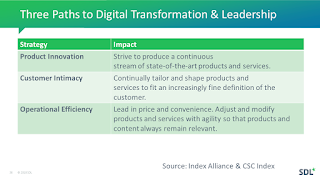
 In a respected paper published in the Harvard Business Review, the authors point out three building blocks that can help drive a modern enterprise into building a market leadership position in this age of digital disruption. The building blocks are summarized in the graphic below.


And for those who look carefully, we can see that MT has now reached a point of being a critical and strategic technology to assist in this digital transformation.  MT enables the communication that enables and underlies product innovation from global teams, helps an enterprise to understand and communicate more effectively with customers across the world, and, also enables efficient delivery of highly relevant multilingual content across the world to build market leadership.


Monday, January 10, 2011

The Most Worthwhile Conferences to Attend in 2011 and Finding the Real Customer

This is an expansion of a conversation I had with Renato Beninatto which he also blogged on and was also video taped here. I am sharing my opinion here not so much because I am endorsing one event or the other, rather this list is just my personal list of preferences and nothing more. I do not claim there is any special status to my personal preferences and you may notice I tend to like conferences where translation technology is emphasized.

We live in an age, where increasingly marketing and corporate-speak is challenged, undermined and sometimes even seen as disingenuous and false. (Raise your hand if you trust and respect corporate press releases).  Today we see customer voices rise above the din of corporate messaging, and taking control of branding and corporate reputations with their own “authentic” discussions of actual customer experiences, while marketing departments look on haplessly. I think this phenomenon is happening on many fronts, including conferences in the localization industry. There are too many events in the L10N industry that seem formulaic, routine, repetitive and engineered based on the same old viewpoints. This, I think affects the ability of these events to really spark dialogue, excitement and generate vital learning experiences that make these conferences must-attend events. While these events remain useful for “face-time”, they often have little value for really engaging attendees at a professional level and providing insights that drive new action plans.

tekomacross
What makes for a great conference or professional industry event? To my mind: high quality content, interactive and engaged audiences in sessions that broaden one’s horizons, interesting people who continue the professional dialogue outside of the sessions and share learning experiences and of course a good location. And if you can offer all of this at a reasonable cost, even better. A great professional event is characterized by learning, the more intensive the learning experience, the better. The best ones leave you thinking for awhile after the event.  Intense learning rarely happens at “really big” events because it is hard to scale this, but hopefully you have a few intense one-on-one interactions.

I also really like events that really focus on the customer: the real customer. The real customer would be the management team that runs, handles and is held accountable for success and failure of international initiatives (rarely the localization department of that company IMO). So the real customer would be senior sales, marketing, product management and customer support people who may also fund and direct the localization department mission in the global enterprise. (We rarely see them at any localization conferences because localization is rarely a central focus for them.) The real customer is more likely to focus on market share trends and customer satisfaction / loyalty  rather than word rates, fuzzy matching rates, TM ownership, SimShip or vendor management.
The question that Ultan O'Broin posed most recently in Quora was:

He also presents a categorization of these conferences as follows Generalist, Specialty and Geography-focused events. He said that he liked to attend one or two of each category and his preferences are stated in the links above. 

I still see myself as more of a pragmatic technology guy, trying to solve meaningful and useful translation problems (hopefully) with technology, rather than an industry insider (not quite a localization professional), so I would organize this a little bit differently but it still has much in common with Renato’s view. For MT especially it is all about understanding and learning how to use it at this point in time.  

I think there are 3 or more categories of conferences that touch localization and translation. The following is my very crude categorization. (Hopefully somebody can suggest a better categorization scheme. Please feel free to tear this apart).
 
1) Traditional Corporate L10N & Translation Focused Conferences
2) Translation Technology & L10N Research Focused Conferences
3) Special Focus & Miscellaneous  and

New Opportunities and Events/Industries/Markets to Explore 
If I limit myself to three or so in each category I would select the following events.
Category 1: Localization World and ELIA are the best in terms of content quality and networking value IMO. Localization World is the largest industry insider event (and the only one where I have seen a real customer view occasionally) and ELIA is a great example of sharing and collaboration between peers and competitors. This is the most crowded conference category and my recommendation would be for people to choose carefully amongst the available options (using location and content as a guide).  There are some who prefer the LISA and GALA versions of this category and they can also be good and sometimes slightly different like the LISA event at UC Berkeley.

Category 2:  TAUS Annual User Conference for MT focus from enterprise customer perspectives, (not the regional meetups held around the world) even though this event has some overlap with the first category.
AMTA for a deep dive on machine translation related issues that covers both the gory details of the technology and its use in public and private sectors, but this event has a very strong US focus.
LRC for broad and innovative localization research and thinking that is truly focused on the next generation of needs.
Translingual Europe 2010:  This was a free event held in Berlin that I think shows promise had much about MT and broader language technology initiatives across the world but especially in the EU. 

Category 3: IMTT events have great content and a wonderful collaborative and sharing culture and I also think are one of the few events where you really get to see both LSP and translator perspectives engage together.
AGIS to understand the issues in the non-profit world where translation is often linked to national development priorities or alleviation of information poverty. A different perspective and much more ambitious initiatives that involve national policy oftentimes. I am willing to bet that the leaders in the non-profit arena will also be the first to really use technology well and drive standards forward. I suspect that the most interesting crowdsourcing initiatives will also come from the non-profit area and passionate community leaders rather than global enterprises.
tekom is an opportunity for  localization professionals to connect to a broader customer community and I hope that more of this happens in 2011. The industry can only grow and gain momentum by becoming more involved with larger broader and vertical market focused shows which are important to real customers.
I think some of the smaller events can also be very interesting e.g. The last LISA Crowdsourcing round table was informative and showed potential and promise but lost momentum because of weak follow-up. I am told that some of the smaller events in Eastern & Southern Europe also have very high quality content and great engagement. Web based events are growing in popularity but very few have found the right mix of content and engagement.

I hope that we will see more events focused on resolving issues around data interchange and exchange standards so that translation data flows much more easily and fewer on process standards.

New Opportunities and Events/Industries/Markets to Explore
Possibly the best and most exciting business opportunities and ability to learn about new long-term strategic opportunities are shows that have been off the beaten path and ignored by most industry insiders.
 
Some possibilities for translation industry collaborations in future and where I think the best opportunities lie for emerging translation and localization demand are listed below. Again just some suggestions and not a complete list by any means. It would be worth finding out which are the best conferences to meet customers, providers and thought leaders in the following areas and develop marketing communications that interest, educate and engage these attendees, on localization and translation issues.
I think video content will be a major new opportunity, and will likely cover all of the above segments. I have seen that there are video subtitling/dubbing focused conferences but have not attended one yet and I suspect that this is an area worth exploring as a long-term opportunity. Video content translation is likely to be the fastest growing new sector for the industry as Cisco estimates that 90% of IP traffic will be video related by 2013. If that is where the end-customer is, it makes sense to focus on it. I am sure mobile will also be a growing and strategic area.
 
Finally, I think we should all be exploring how to get more connected in to BRICI global commerce focused events. (This is more complicated than holding an event in China and/or India.) It is very likely that as the export/import sectors in these fast growing countries expands there will be events and conferences, that will be worth tapping into to really get access into these markets. I would bet that the best events will be organized by locals in these regions who are interested in globalization issues, possibly even government sponsored events.

Please join the discussion on Quora or comment on this blog as this is by no means a definitive or authoritative list. What do you think? And lets hope that we all find “a real customer” at the events we go to.
dialogue

Tuesday, October 26, 2010

Megatrends and Their Impact on Professional Translation

I have recently made public presentations to audiences of LSPs and localization professionals about broad trends affecting the world of professional translation. My perspective seemed to resonate and I thought it might be useful to put the core message in a blog entry and share it, to possibly get critical feedback or extend the discussion. In some ways I have touched upon these “megatrends” in earlier blog entries (Why MT Matters, The Data Deluge, Translation Technology, Innovation in Localization)  but it is useful to bring it all together in a single place.

I am aware that others are making similar points but I think this summary incorporates conversations I have heard around the web and is closer to the collective intelligence. The trends in brief are as follows:
  • There is an explosion in relevant content affecting global enterprises
  • Social Media and Social Networks are now increasingly in control of branding impressions
  • There is an increasing use of open innovation and community collaboration models in many businesses
  • Translation technology and automation are becoming increasingly important for speed and cost reasons
  • A rising Asia will change the priority of strategic languages away from the current FIGS dominance

The Content Explosion

Data Growth Trends
We are seeing exponential growth in the digital universe and much of it is very relevant to global enterprise concerns. It is important to understand that this is happening on a scale never before seen in the history of man. A lot of this content is related to facilitating global commerce so understanding this becomes highly relevant for the global enterprise.
Enterprise Content

The Impact of Social Networks and Customer Conversations

The carefully calculated marketing and corporate image control that global enterprises have been used to is also coming undone. Brand impressions are increasingly being formed by real customer conversations in social networks. We see that the world of marketing is undergoing a transformation and what used to be considered critical corporate messaging is increasingly viewed as “corporate-speak” and is often not trusted by the end-customers who matter the most. Jeremiah Owyang wrote a prescient blog entry three years ago where he predicted this shift and increasingly the corporate website is seen as a place where pro-corporate bullshit resides. More and more, the high value content is being created by customers and business partners and corporations have little editorial control of this content creation process.

UGC Impact

The Growing Importance of Open Innovation & Collaboration Models

We are also seeing that co-creation of products and services with customers can be a huge momentum builder. Facebook has shown that engaging users in translating interfaces can also help accelerate building the customer base in those languages. Their international growth has been closely linked to their crowdsourcing translation efforts even though crowdsourcing can be less predictable.  Dell actively solicits and nurtures active customer feedback in IdeaStorm to develop new products. Collaborating with customers and partners is emerging as a way to to engage customers, build loyalty and accelerate penetration in new markets. There are very few large companies that have figured out how to do this because open collaboration is a huge cultural change from the command and control mentality that most executives work with. In the B2B world this may also mean that customers prefer best-of-breed solutions to one-stop solutions. Diversification is generally considered a wise investment strategy and is increasingly understood to be a good way to build business infrastructure and avoid vendor lock-in even though it may also mean more integration work.

 The Rise of Asia

Western Europe and FIGS have dominated the professional translation world historically. While FIGS will remain important, in the future it looks like Brazilian Portuguese, Spanish will be the most important European languages and Chinese, Hindi, Indonesian and other Asian languages will become increasingly more important and strategic as global revenue generating translation investments. Many companies now are expanding their base of languages and the FIGS-CJK view is slowly receding.The graphic below is clear in it’s implications: Asia offers substantial commercial opportunity for those who make the localization investments. I have written previously about how Asia is a long-term opportunity for truly global companies. (I will update it shortly as the momentum keeps building.) There are many market potential studies that suggest Asia offers significant opportunity for IT infrastructure, mobile devices, luxury goods as well as new bottom of the pyramid (BOP) product opportunities.
Strategic LPs

What Does All This Mean?

So if we add all this up it shows that global enterprises are facing a content deluge with dynamic content coming from both internal and external sources and high volumes of this content is expected to be translated increasingly faster to have any value in competitive situations. Global enterprises that quickly identify high value content and make it multilingual will find that this can drive international revenues and that translation can be a strategic tool to building long-term competitive advantage.

Now, more than at any other time in history, speed and agility are decisive competitive advantages...David Meerman Scott

However this is a time of revolution, and the TEP (Translate-Edit-Proof) and SDL (Software and Documentation Localization) mindsets are not likely to be adequate to meet these new translation challenges. The old approach worked for static, low volume content but new thinking and new approaches are required to deal with the data deluge today. Automated translation is an absolute necessity in the new world but this is not the MT of yesteryear that many are still implementing and describing at localization conferences today.

Old Approach Cant Work
In the new world, data has to flow from content creation to consumption as seamlessly as possible, delivered to where it is needed at desired quality levels. This means that humans need to be part of the production process and are the key to producing the best quality. The future is about much better man-machine collaboration. The automated translation tools need to be learning and getting better all the time. They need to be responsive to skilled human linguistic steering and corrective feedback. They need to be focused on dynamic streams of content not just static, packaged translation projects like user documentation. They need to understand that with flowing content, upstream cleanup efforts will flow through the production line and make every downstream process easier and more efficient. They see the information cycle as a system, as organic and thus build the collaboration infrastructure to address the whole problem. They need to see MT systems improve with human steering, in weeks, not months or years. They need to be MT systems that can be trained and managed by skilled professionals to get you to “good enough” production quality “fast enough” to have a positive impact on your business, not the black box MT of yesteryear. If you look closely there are very few choices in reality. (Think Asia Online!)
Localization Trends

Have you noticed that Google and Bing Translate improve regularly since they shifted to statistical MT (SMT)? Does that tell you something? Why did we not see these improvements when these same companies were RbMT based?  On domain focused systems the progress and quality improvements are even more compelling. I have recently seen Asia Online systems compared to heavily customized RbMT “hybrid” systems, and it is clear that the yield to effort ratios with hybrid SMT approaches are clearly superior, (I am of course biased) but the evidence continues to mount. (BTW Moses is perhaps 5% of what is needed to accomplish this). In the future professionals will undertake to translate content streams that contain tens of millions of words that encapsulate important customer conversations. If translation is strategic make sure that you align with technology that can go the distance and that has demonstrated the ability to evolve.
New Requirements for MT
As more senior corporate executives realize that translation is strategic, and that translation technology properly used can generate substantial revenue in global markets, they will start to look at solving these new kinds of translation problems. Executive managers are unlikely to be excited by the possibility of getting user documentation done faster and cheaper. However, as they start to get their hands around the fact that customer conversations are important (many are struggling with this), and that they need to respond with speed and agility to build global customer relationships, we can expect to see a new kind of executive who will seek to make flowing content multilingual. They will care that real standards exist (not SDL versions) and will likely remove products that do not comply. Handling the flow efficiently will become the focus, and the most visionary localization managers may even have senior roles in making this happen. Speed and agility are key and customer engagement across the globe will require a real understanding of how to make these dynamic content focused translation systems work. There is a video of an extended presentation version of this blog available from the Localization Technology Roundtable seminar (starts at about 4’30” after introduction). (Yes, I need to lose weight or at least wear shirts that are not so tight).

We are living in a time of great change. In times of change there is often an opportunity for new paradigms and new leaders to launch, remember MSFT grabbing the desktop market away from IBM and Google grabbing away the web search market from MSFT?  New leaders with new visions are the change agents that make this happen, and they are often dismissed by the established status quo and “leaders” of the time. I do not see that new MT initiatives by Lionbridge and SDL really address these new needs. I think there is too much of the old view in their approach,  but I may be proven wrong. I am skeptical that the current “market leaders” have the vision and/or culture to drive this change and I think we will see somebody from outside the industry or smaller, more agile LSPs be the driving force of this coming change. For current leaders to be change agents often means cannibalizing current revenue streams and very few have succeeded in crossing that chasm. We shall see as this unfolds.

In revolution, the best of the new is incompatible with the best of the old. It’s about doing things a whole new way...Clay Shirky

Anyway these are truly interesting times, and it looks like things will get even more interesting. 

Friday, October 8, 2010

Highlights from the TAUS User Conference

Earlier this week, there were a 100+ people gathered in Portland,Oregon at the TAUS annual user conference. This included a large contingent of translation buyers, mostly from the IT space - (Intel, Oracle, EMC, Sun, Adobe, Cisco, Symantec, Sony),  a few LSPs with real MT experience and people from several MT and translation automation technology providers gathered to share information about what was working and what was not. Like any conference, some presentations were much more compelling and interesting than others, and I wanted to share some of the things that stood out for me. It was not always easy to tweet, since the connectivity faded in and out but a few of us did try to get some coverage out. CSA also has a nice blog entry on the event that focuses on the high level themes. I think that some of this will be made available as streaming video eventually.

If you are interested in the business use of machine translation this was a  useful event and it showed you many examples of successful use-cases and also get technology presentations from MT vendors in some depth, perhaps too much depth for some. There was a full day that was filled with MT related presentations from users, MT tool developers and from LSPs using MT. Some of the highlights:

Jaap stated that translation has become much more strategic and that global enterprises will need language strategies. He stated that he felt that there would not be any substantial breakthroughs in MT technology research in the foreseeable future. I actually agree with him on this, in the sense that the rate of improvement from pure MT technology research alone will decline, but I believe that we are only at the beginning of the improvements possible around better man-machine collaboration. It is my opinion that the many of the systems presented at the event are far from the best systems possible today with the technology and people available today.  Another way to say this is that I think the improvements from free online MT will slow down, but the systems coming from professionals collaborations like Asia Online has with LSP partners will rise rapidly in quality and show clearly that just data, computers and algorithms are not enough. I predict that collaboration with skilled, focused and informed professional linguistic feedback (LSPs) will drive improvements in MT quality faster than anything done in MT research labs. The two most interesting pure MT technology  presentations included an overview of morpho-syntactic SMT (a hybrid with 500M rules! from Kevin Knight at USC/ISI) and the overview of a “deep” hybrid RbMT approaches from ProMT where statistical selection is introduced all through the various stages of an enhanced RbMT transfer process. This is in contrast to the “shallow” hybrid model used by Systran which uses SMT concepts as a post-process to improve output fluency. All the RbMT vendors/users stressed the value of upfront terminology work to get better quality. For those of you who heard the presentation that Rustin Gibbs (mostly, who was also a star performer at the conference) and I did, will know that I am much more bullish on what a "vendor-LSP collaboration"  could accomplish over any technology-only approach.


It was good to see (finally!) that many, including Jaap admit that data quality and cleanliness do matter in addition to data volume.


Several people came up to me and mentioned that they had experienced that sometimes less is more, when dealing with the TDA data. TM cleaning, corpus linguistics analysis to better understand the data and assessing TM quality at a supplier level at least is now a recognized and real issue that is getting  more attention within TAUS. There were several presentations that mentioned data quality, “harmonizing terminology”, TM scrubbing and strategies to reduce the risk of data pollution when large amounts of TM are gathered together.  The TDA database now has 2.7 billion words and TAUS admitted that it has become more difficult to search and use and thus they are integrating the data into a Globalsight based repository to make the data more usable. They are hoping to add more open source components to further add value to the data and it’s ongoing use. Their ability to further refine this data and really standardize and normalize it in useful ways will define the TDA’s success as a data resource in future, in my opinion.

There was an effective and very interesting point counterpoint session (unlike the ones I have seen at GALA) between Keith Mills, SDL and Smith Yewell, Welocalize that positioned the “practical” legacy system view versus the open systems view of the world. It really did justice to both viewpoints in a common framework and thus provided insight to the careful observer. It was interesting to see that SDL used the word “practical” as many as 30 times while presenting the SDL view of the world. In brief, SDL claimed that they will spend $15M in 2010 on R&D to create a platform to link content creation more closely to language. He said that SDL does not make money on TMS because there is too little leverage due to too many one-off translation processes. He also said that SDL will not go open source but was “really into standards” and will create APIs to “let” customers integrate with other software infrastructure. 

Smith presented his view of a world in contrast to the “walled garden” of SDL that was interoperable, “open” and collaborative and involved multiple vendors. Keith responded they will “eventually” connect to other products and “are working on it,” with counters on how closed black boxes make it difficult to scale up and meet new customer requirements of translating fast flowing content from disparate sources. It was interesting to see Jaap characterize the debate saying that perhaps Smith was “too visionary” (a nice way of saying impractical?)  and that the SDL perspective is “realistic and practical”. I actually have captured the flow of the debate in my twitter stream. Keith also made good points about how MT must learn to deal with formatted data flows to be really usable but seemed to completely miss the growing urgency for language data to move in an out of SDL software systems. Smith also pointed out that MT is not revolutionary, rather it is just another tool that needs to be integrated into the right business processes to add value. I liked the debate because it accurately presented the two viewpoints in an authentic way and let you see the strengths and weaknesses of both perspectives. I, of course, have an open systems and collaboration bias but this session gave me some perspective on the value of the walled garden perspective as well. 

I had some back channel Twitter chatter with @paulfilkin and @ajt_sdl about what meaningful openness means. In my view SDL does NOT have it. My advice to SDL on this is to share API information like the TAUS API, that is published for self-service use and so any customer/member can connect to get data in and out of the TDA repository efficiently. Facilitate the work to let the data flow and give customers enough information (API, SDK) so that they can do this themselves without SDL permission and move language data to wherever it is needed easily e.g. TMS to TMS, TMS to TM, TMS to CMS, TMS to MT, TMS to Web. They should provide basic information access for free and customers should only be required to pay for this if they need engineering support. SDL needs to understand that language data can be useful outside of SDL tools and that they can make this easier by delivering real openness to both their customers and the overall market.  I have written about this previously. My advice and warning to customers – stay away from SDL until they do this or you will find yourself constantly wounded and tending to “integration friction”. 

One thing that I found really painful about the conference was a horrendously detailed continuing presentation (it refused to end) on the history of MT. I am not sure that there is anything to be learnt from such minutiae. For me this is clearly a case where history was horrifically boring  and did not teach any real lessons. It made me want to poke my eyes and see how much pain I could tolerate before crying out. I hope they never do it again and that the presentation and recordings are destroyed.

I also feel that the conference was way too focused on “internal” content. That is, content created by and within corporations. It is no surprise that SDL (which originally stood for Software and Documentation Localization) is so committed to the walled garden since in the legacy world, command and control has always been the culture, even within most global companies. In an age where social networks and customers sharing information with each other increasingly drives purchase behavior, this is a path to irrelevance or obscurity. I am not a big believer in any Global Content Value Chain (GCVS) that does not have a strong link to high value community, partner and customer created content. The future is about BOTH internal and external content. I think the TAUS community would be wise to wake up to this, to stay relevant and attract new and higher levels of corporate sponsorship. We should not forget that the larger goal of localization and translation efforts is to build strong relationships with global customers.  Conversations in social networks is how these relationships with brands and customer loyalty are being formed today. Localization will need to learn to connect into these customer conversations and add value on behalf of the company in these living, ever present conversations happening mostly outside the corporations content control initiatives. Richard Margetic from Dell said it quite clearly at Localization World Seattle: “Corporations will have to take their heads out of the sand and listen to their customers, we believe that the engagement of customers on Twitter is critical to success (and sales)” He also said “We had to teach our corporate culture that negative comments have value. It teaches you to improve your products” and I hope that the TAUS board will take my comments in that spirit.

There was surprisingly little discussion about data sharing and the focus had moved to much more pragmatic issues like data quality, standards, categorization and meaningful identification and extraction from the big mother database but there were few details on this other than some basic demos of how Globalsight and the search engine worked. If you have ever seen a database search and lookup demo you will know that it is seriously underwhelming. The TDA is great if you are looking for Europarl or IT data but is pretty thin if you want data in other domains. A lot of this data is available elsewhere with no strings attached. The TDA needs to give people a reason to come to their site for this data.The value of TDA in future, IMO, is going to depend on how they add value to the data, normalize it, clean it and categorize it.  This to my mind is the real value creation opportunity.  They also need to find ways to attract more people who are not from the localization world but have an interest in large scale translation. Additionally I believe they should expand the supervisory board beyond IT company people to increase the possibility of being a real force of change. When everybody has the same background, groupthink is inevitable. (Aren't they forced to watch those workforce diversity presentations that I was forced to when I was at EMC?) I suspect that open innovation / collaboration models will be more likely to come up with ways to add value to data resources and new ways to share data and hopefully TDA finds a way to engage with people like Meedan, TRF, Yeeyan and other information poverty focused initiatives. While there was a focus on innovation and collaboration I got the feeling that it was too focused on getting more open source tools and nothing else. I think open innovation needs more diversity in opinion and ideas than we had in the room. What is open innovation?  Henry Chesbrough; “Open innovation is a paradigm that assumes that firms can and should use external ideas as well as internal ideas, and internal and external paths to market, as the firms look to advance their technology”

Here is a presentation on Data Is the New Oil. I think the point they make is very useful to TDA: Refine, Refine, Refine to create value. Value is getting the right data to the right people at the right time in the right format. I think it is worth finding out what that actually means in terms of deliverables. Make it easy to slice and dice and package and wrap. 

Some of you who know me, know that I am a Frank Zappa fan and Frank (well ahead of his time as usual) said it well in 1979 on the Joe’s Garage album: (I would add “Data is not information” for this blog and recommend you look at more Zappa quotes)

"Information is not knowledge.Knowledge is not wisdom.

Wisdom is not truth.Truth is not beauty.

Beauty is not love, Love is not music.

Music is THE BEST" 


Finally, one thing about conferences is that there are always a few conversations that stand out. While there were many professional conversations of substance, for me, the ones that stand out the most are conversations that come from the heart. I was fortunate to have four such conversations at this event. One with Elia Yuste of Pangeanic about building trust, another with Alon Lavie of AMTA about where innovation and the real exciting MT opportunities will come from, a third with Smith of Welocalize about building openness with substance, integrity & honor and finally a conversation with Jessica Roland about life, finding purpose and family. I thank them all for bringing out the best in me.


As I prepare for my ELIA keynote, I am compelled to share one more quote that I think is worth pondering:


In revolution, the best of the new is incompatible with the best of the old. It’s about doing things a whole new way… Clay Shirky

Wednesday, February 10, 2010

Making Customer Support Content Multilingual

One of the largest new opportunities for the professional translation industry is in the Customer Support departments of high technology or industrial engineering global companies. I have briefly described the reasons why, but I thought that it would be worth elaborating on this further. 

Many global companies, especially those that are members of the Consortium for Service Innovation realize that a major new trend that they face is the growing power of the community and self-service in the Web 2.0 age. We see that already 98% of customer support interactions of an average global high tech company happen in self-service and the community forums. This is a major shift. However, the focus and much of the resource allocation in companies is still on the call support center and relatively static documentation and content which the professional translation industry is involved with. This makes less sense every day as evidence suggests that the customer experience is often formed by how support problems are handled. As the CSI points out, this is done mostly by self-service content and the “community” outside of corporate control.

GCSE Non-Anglo

If English speaking customers choose to solve their problems in this way, it follows that most global customers will also want to do the same. However, the content available to the global customer is often a fraction of what an Anglophile can get to and so non-English speakers are often left frustrated. There is now clear evidence of the following:

-- The customer support experience is increasingly formed outside the call center and customers strongly prefer self-service and community support.
-- The support experience is often critical in forming customer perceptions and developing brand loyalty.
-- Global customers do not have as much local language information access and thus probably have a less satisfying support experience.
-- Making much more knowledge and product support content available is a key to generating a better support experience.
-- Good self-service knowledge base content and greater visibility to high quality community content can greatly enhance the customer experience.
-- There is a clear relationship between customer loyalty and increased revenue and probably repeat purchase.

This situation presents a significant opportunity for the professional translation industry. However, given the huge volumes of content that need to be made multilingual it is important and necessary that automation be a key component of the multilingual content development strategy.  Microsoft was a pioneer in doing this, and they showed that hundreds of millions of customers were willing to use machine translated knowledge base content. Until recently they had all the knowledge base content available in at least 9 languages and are expected to expand this to more languages in future.

The benefits of global enterprise making large amounts of support content multilingual are significant, both financially and in terms of positive customer as the following graphic shows. Not only is self-service content a HUGE cost saver it can also create real positive brand perceptions. 

Call Deflection Benefit

The highest quality content production process will always need a high degree of human steering and expert linguistic guidance. Machine translation without humans may not provide the translation quality necessary to provide a positive support experience. The professional translation industry has a major opportunity ahead as major global corporations begin to act on this trend.

The role of customer support is shifting from answering questions and solving customer problems to facilitating a network of people and content. The Consortium’s research shows that the majority of the customer support experience is with content; not with people. The benefit of offering that content in the language of the customer is huge.

I will continue on this theme for at least another blog entry. I strongly recommend that you take a look at the CSI website as it is filled with great information and research on what is going on in the world of Customer Support.

Quote from the CSI web site:
Rather than continuing to invest in doing what we do faster, better, and cheaper, maybe we need to look at doing something altogether different... maybe there is a lesson for the localization industry in this.