Pages

Showing posts with label standards. Show all posts

Tuesday, September 20, 2022

The Localization Tech Stack Evolution

 As the world moves increasingly to a “digital-first” approach across the business and government spectrum, it has become increasingly clear to any enterprise interested in reaching a larger digital population, that providing more multilingual content matters, and that the demand for more translated content will only grow, which also means that enterprise translation capabilities will need to be pervasive and scalable.

The challenge for globalization managers is further complicated by the increasing focus on customer experience (CX) which means that the content can vary greatly, in volume, velocity, and value to customers and internal stakeholders. All content does not need to go through traditional localization production and quality validation processes.

Content that is focused on understanding, communication, and listening does not require the same linguistic quality assurance, and in the digital space, user-generated and other external content is now often the most impactful content to consider.

Modern-era globalization managers need to understand what matters most to customers and balance their focus on the “mandatory” legally required content that localization has typically focused on, against the non-corporate content customers find most useful.

Though the value and business benefit of large-scale translation and localization are now well understood, globalization and localization managers tasked with making the global customer outreach happen, struggle with this objective.

They are faced with a fragmented, inconsistent, and fractured technology landscape and many sub-optimal tools currently exist in the language technology marketplace shown in the graphic below.

These tools are needed both to perform the many specific tasks involved in any globalization effort and to help establish structured processes that enable ongoing and emerging global customer-focused needs to be efficiently serviced.

Given the wide variety of tools and the diversity of the people needed to effectively execute the multiple globalization processes involved, straightforward and efficient data flow from sub-system to sub-system is desirable.

Successful globalization outcomes are often directly linked to enabling fast-flowing, unhindered data flows through a variety of translation-related processes. This is a necessary condition for success in a digital-first world.

However, what many Loc Buyers find is that some of the systems and tools they use impede and obstruct this smooth data flow, and thus the digital globalization initiative is often undermined and overly focused on repairing broken and problematic data flows.

If we look at the TMS part of the tech stack more closely, we can understand the challenge that globalization managers have when making long-term decisions on what their tech stack should look like. There are many choices, and identifying the specific characteristics of a superior system is not so clear.

We have learned that the best AI outcomes are driven by high-quality data above all else, and thus selecting technology that facilitates ongoing data access as technology changes, should be a prime concern and strategy for any forward-thinking globalization manager.

The critical technology components for most localization managers include the following categories:

1.      CAT Tools used by translators

2.      Translation Management Systems

3.      Language Quality Assurance (LQA) Tools

4.      Enterprise-capable MT

5.      Audiovisual Translation tools are growing in importance

In general, it can be said that the better the integration between these key components is, the more successful the globalization outcomes and the more efficient the enterprise will be in providing a high-quality global customer experience.

Unfortunately, the reality for many localization teams is focused on repairing broken or non-existent connections between sub-systems, and building better data sharing between the various components in their back-end localization tech stack to power the customer-pleasing expanded multilingual CX.


Avoiding Lock-In with Proprietary Systems

As the enterprise matures in localization and globalization sophistication, it will likely develop and build valuable linguistic assets over time. These linguistic assets need to be easily accessed and available to be shared with emerging new tools and platforms that provide business leverage, powered by new AI capabilities, as customer needs and CX imperatives dictate.

The tech stack complexity challenge for globalization managers is further exacerbated by the fact that much of the technology is still evolving.

Thus, any technology component that creates lock-in and prevents the straightforward transfer of linguistic assets to new superior language technology tools or platforms as they become available IS TO BE AVOIDED.

These siloed systems create what is called Tech Debt. This refers to the off-balance-sheet accumulation of all the technology work a company needs to do in the future. Tech debt results from software entropy and a lack of integration between different systems and data.

And it’s not just a minor inconvenience. A majority of businesses say that tech debt is slowing their pace of development, and resulting in real-world losses in sales and productivity.

Tech debt can produce several negative consequences for businesses:

The benefits of reducing tech debt are also significant and include:

Buyers should demand that enabling straightforward API access to client linguistic data without restriction or restraint should be a basic and critical requirement for any modern enterprise software solution or TMS.

Sophisticated new capabilities emerging from NLP research in Large Language Models, Responsive MT, and other emerging Language AI research will be almost useless to those companies that cannot quickly move relevant enterprise linguistic data to these new applications. They will be unable to properly explore possibilities of providing better CX with emerging linguistic AI capabilities.

This data lock-in is especially true for some of the current TMS systems that create multiple layers of technical, and even legal obstacles to straightforward data sharing. These obstacles invariably trap some Loc Buyers into sub-optimal workflows and solutions.

It is surprising that more Loc Buyers do not understand the importance of free and easy access to all linguistic data over the long-term, and suggests that Loc Buyers are extremely naïve in terms of making technology evaluations and selections that stand the test of time.

Sub-optimal initial choices will require regular overhauls in the technology stack to overcome obstacles created by proprietary lock-in technology.

Data is the lifeblood of any organization and the backbone that supports the creation of market-leading CX. The AI-driven world of tomorrow will be increasingly data-driven.

However, it is nearly impossible to make this data actionable in marketing activations and other business processes without data centrality and shareability. To avoid this, globalization managers should look for partners who can help them democratize their data sets so that they’re integrated and accessible by all.


The Growing Importance of Integration with Enterprise IT

Translation technology has reached an inflection point, as translation connects to the major trends affecting every industry: big data, cloud computing, and artificial intelligence (AI). Language platforms that can scale from millions to billions of words of translated content per month are being created as enterprise buyers and innovative language service providers seek to align their language systems with the technology stacks of globally focused enterprises.

Implementing many different systems and sources that don’t speak to each other will make it harder for the business to enact data-backed decisions and integrate with core IT functionality. Straightforward integration with core enterprise IT is a key requirement to enable successful global CX outcomes.

The ability to quickly import, clean, and use data from countless sources is critical to marketers and globalization managers, but rarely easy.

One of the barriers to realizing this data actionability stems from rigid data structures that can’t onboard, transport, and unify both structured and unstructured data from different sources. Flexible data architecture and a scalable hygiene framework can speed up the timeline for data activation and value creation.

The chart above shows the relationship between translation quality and content volume. It also shows that the highest returns on investments in translation technology will come from those areas focused on global CX and eCommerce.

The collaboration between localization teams and enterprise IT teams are growing in sophistication and now increasingly both internal corporate data and external data from social media and customer reviews are being mingled and merged to provide better CX.

This often requires handling large volumes of user-generated content (UGC) and monitoring social media brand impressions which are so voluminous that traditional localization workflows are not valid.

UGC is a dominant element of the eCommerce content landscape and even presents special challenges for MT technology. UGC content is often written by non-native speakers and, most likely, by non-professional content writers and thus needs specialized treatment and a different approach from typical localization content. But we see today that global market leaders learn to do this at scale, with new techniques that assume and drive evolutionary quality improvements.

Tech-savvy localization managers who understand this “start now and improve gradually approach“ on massive content volumes are now being seen as vital partners in global growth strategies. Best practices suggest that the most effective strategy is to have MT and Human translators working together to build a continuous improvement cycle.

The strategy to translate a billion new words across multiple use cases every month has to be different than a typical localization translate-edit-proof (TEP) process. This is made difficult or even impossible with TMS systems that do not allow easy access to ALL linguistic assets.

Airbnb is an example of emerging localization leadership where the localization team is seen as a vital partner in enabling global growth and works closely with IT, Legal, and Product teams to deliver better global customer experiences.

The Airbnb localization team oversees both typical localization content and user-generated content (UGC), across the organization, which means they oversee billions of words a month being translated across 60+ languages using a combined human plus continuously improving MT translation model. The localization team enables Airbnb to translate customer-related content across the organization at scale. High-value external content is often given the same attention as internally produced marketing content.
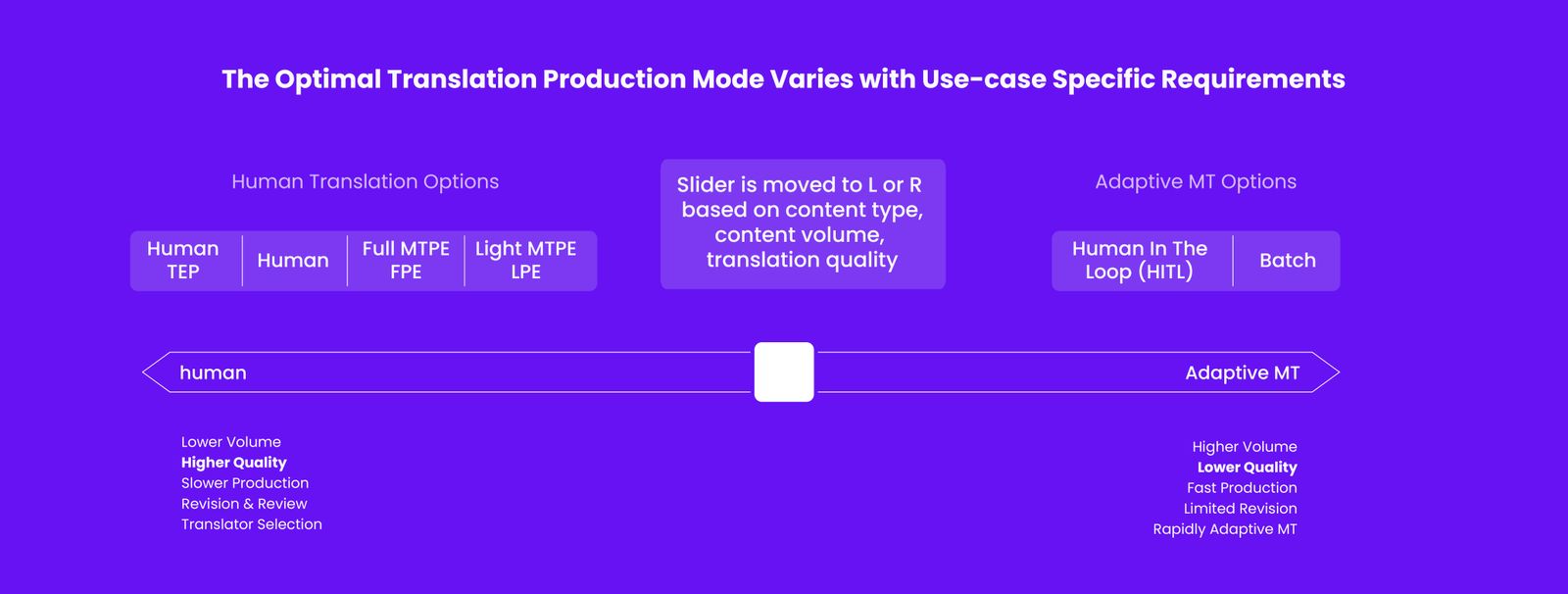
When dealing with CX-focused translation scenarios, the business requirements direct globalization managers to focus on optimizing the translation production mode to the volume, speed, quality requirements, and the value of the content to customers.

This is a clear shift away from the traditional LQA-focused localization workflows where TMS systems have traditionally been useful.

TMS systems have been most useful in relatively low-volume, complex workflows that involve multiple levels of human touch on the translated content. This is the top left-hand corner of the chart above. TMS systems add little to no value in scenarios with high volume fast flowing CX data where data flow straight from MT to dissemination.

Dated monolithic translation management systems (TMS) are giving way to micro-service and cloud-based architectures, with machine learning driving systems toward enterprise-scale automation where speed, scale, and the value of the content to the global customer matter more than achieving perfect linguistic quality.

Thus, increasingly we see that TMS systems are completely bypassed or irrelevant, and there is greater use of “raw MT” or carefully pre-tuned MT rather than fully post-edited MT.


The Emerging Requirements for a Language Platform

As more senior executives in the global enterprise ask questions like:

  • How do we integrate our international strategy with our overall corporate strategy?
  • What will this take in terms of people, process, and technology?

We should expect a shift to language as a feature at the platform level wherein language is designed, delivered, and optimized as a feature of a product and/or service from the beginning.

Language accessibility is integrated into content and procedural workflows that affect almost everyone within the organization at some point. Something that analysts call a "language platform."

Rebecca Ray of CSA describes the impact of producing relevant content for modern eCommerce marketplaces at scale and touches upon the key requirements of a Language Platform.

The success of globalization leaders like Airbnb demonstrates the value of developing comprehensive and collaborative capabilities with a more globally embedded and pervasive translation-focused ecosystem. The Airbnb deployment is a pioneering example in global CX best practice that shows how extensive and deep-reaching translation workflows can be integrated into corporate IT when the value is understood at executive levels.

A CX-focused and capable Language Platform that is ready for digital-first globalization and localization challenges would need all of the following key components working together in a highly integrated and seamless manner.

  • Essential TMS capabilities to monitor translation projects, and linguistic quality, and generate and manage critical translation workflows for different content types as needed.
  • An adaptive and continuously improving MT system that automates personalization and performance optimization for each enterprise customer and manages the collection of corrective feedback across dozens of enterprise use cases. This element is increasingly becoming the most important element of the back-end tech stack and the heart of the Translation Engine to provide superior global CX.
  • Computer-assisted translation (CAT) tools to enhance translator productivity, simplify project management, and share corporate linguistic assets like translation memories (TMs), glossaries, and terminology. In the modern era, CAT tools would also need to handle video, audio, and other social media-focused multimedia data.
  • Open and service-based architecture to allow continuing evolution of translation processes and addition of new core functions powered by machine learning with speed and agility. Linguistic assets are maintained in a continuously leverageable state so that these assets can be connected to emerging linguistic AI technology without hindrance or restraint.
  • Connectors: As the need for an Enterprise Translation Engine becomes more apparent the Language Platform will need to connect to CMS, Marketing Automation, Customer Data Platforms (CDP), CRM, ERP, Messaging, and Customer Support & CX platforms, in addition to leading social media to listen to and monitor customer conversations.

Look for a partner rather than a vendor, that can help you simplify and rationalize your tech stack and the increasing amounts of data you’re ingesting. Instead of logging in to different systems repeatedly according to content type and purpose, look for a vendor who can consolidate these into one simplified view. Additionally, ensure that data can be shared across vendors in this centralized hub so that you can leverage the power of these insights across the scope of your audience.


The Translated Tech Stack

TranslationOS is a hyper-scalable translation platform, that directly connects clients with translators that also provides management access to translation-related KPIs. It also provides the technical foundations to build a next-generation Language Platform.  It provides customizable dashboards that give globalization managers access to KPIs, project status, quality performance, and linguist profiles.

TranslationOS is a technology platform that allows straightforward access to client data whenever it is required for other downstream applications, or just for internal archival purposes. Client linguistic assets always remain within easy reach of the client's developers to support other valued added processes that can arise over time.

TranslationOS is also the overarching technology that tightly ties together enterprise translation memory, adaptive MT and corrective feedback management, CAT, and multimedia data management tools.

TranslationOS has a growing set of content connectors enabling external data ingestion and export to enterprise IT infrastructure.

TranslationOS includes an AI-driven translator matching tool (T-Rank) to ensure optimal selection from a qualified, and continuously verified pool of 400,000 translators for different projects using 30+ factors (e.g., availability, historical performance, subject matter experience, qualifications) to drive objective rankings to ensure the identification of the best-suited resources.

ModernMT is an adaptive MT system that is highly flexible, responsive, easy to manage and maintain, continuously learning, and able to incorporate ongoing human corrective feedback to ensure better MT output.

It consistently shows up as a top-performing MT system in independent third-party MT quality evaluations even before it has been adapted and tuned to specific enterprise content. It seamlessly integrates into TranslationOS and leading CAT tools like MateCat, Trados, and MemoQ.

In 2022 it has also been integrated with MateSub and MateDub to enable the automated translation of corporate multimedia content.

MateCat is a free, open-source, performance-oriented online CAT tool that allows translators to easily share TMs, and glossaries and interact dynamically with ModernMT to ensure continuously improving MT suggestions. It is integrated with MyMemory, a massive, yet clean TM gathered over 20 years, to augment and increase TM matching possibilities.

MateSub is a CAT tool optimized for subtitling tasks. It combines state-of-the-art AI (auto-spotting, auto-transcription, auto-translation) with a powerful and easy-to-use editor to let you create higher quality subtitles, dramatically faster.

MateDub is an AI-powered tool to assist in voice-over dubbing projects which can add digital voices synthesized from human voice-actor sampling. It allows users to dub videos by simply editing text.


As we move more deeply into the "digital-first" age, we will also move beyond the reach of traditional language technology like TM and TMS systems for more of our translation needs.

We are going to see much more focus and discussion on Language Platforms, Translation Layers, and Translation Operating Systems for fast-flowing CX-related data that are also built on much more open, new integrations-friendly, and transparent technology stacks.


Monday, September 12, 2011

Understanding Where Machine Translation (MT) Makes Sense

One of the reasons that many find MT threatening I think, is the claim by some MT enthusiasts that it that it will do EXACTLY the same work that was previously done by multiple individuals in the “translate-edit-proof” chain without the humans, of course. To the best of my knowledge this is not possible today, even though one may produce an occasional sentence where this does indeed happen. If you want final output that is indistinguishable from competent human translation, then you are going to have to use the human “edit-proof” chain to make this happen.
image

Some in the industry have attempted to restate the potential of MT from Fully Automated High Quality Translation - FAHQT (Notice how that sounds suspiciously like f*&ked?) to Fully Automated Useful Translation – FAUT. However, in some highly technical domains it is actually possible to see that carefully customized MT systems can outperform exclusively human-based production, because it is simply not possible to find as many competent technical translators as are required to get the work done.
image

We have seen that both Google and Bing have gotten dramatically better since they switched from RbMT to statistical data-driven approaches, but the free MT solutions have yet to deliver real compelling quality outside of some Romance languages, and the quality is usually far from competent human translation. They also offer very little in terms of control, even if you are not concerned about the serious data privacy issues that their use brings to the user. It is usually worthwhile for professionals to work with specialists who can help them customize these systems to the specific purpose they are intended for. MT systems evolve and can get better with with small amounts of corrective feedback if they are designed from the outset to do this. Somebody who has built thousands of MT systems, across many language combinations, is likely to offer more value and skill than most can get from using tools like Moses building a handful of systems, or even the limited dictionary building input possible with many RbMT systems. And how much better can customized systems get than the free systems? Depending on the data volume and quality, it can range from small but very meaningful improvements to significantly better overall quality.

So where does MT make most sense? Given that there is a significant effort required to customize an MT system, it usually makes most sense when you have ongoing high volume, dynamically created source data and tolerant users or any combination thereof. It is also important to understand that the higher the quality requirements, the greater the need for human editing and proofing. The graphic below elaborates on this.
image

While MT is unlikely to replace human beings in any application where quality is really important, there are a growing number of cases that show that MT is suitable for:
  • Highly repetitive content where productivity gains with MT can exceed what is possible with just using TM alone
  • Content that would just not get translated otherwise
  • Content that simply cannot afford human translation
  • High value content that is changing every hour and every day but has a short shelf life
  • Knowledge content that facilitates and enhances the global spread of critical knowledge, especially for health and social services
  • Content that is created to enhance and accelerate communication with global customers who prefer a self-service model
  • Real-time customer conversations in social networks and customer support scenarios
  • Content that does not need to be perfect but just approximately understandable

So while there are some who would say that MT can be used anywhere and everywhere, I would suggest that a better fit for professional use is where you have ongoing volume, and dynamic but high value source content that can enhance international initiatives. To my mind, customized MT does not make sense for one-time, small localization projects where the customization efforts cannot be leveraged frequently. Free online MT might still prove of some value in these cases, to boost productivity, but as language service providers learn to better use and steer MT, I expect that we will see that they will provide translators access to “highly customized internal systems”  for project work, and the value to the translators will be very similar to the value provided by high quality translation memory.  Simply put – it can and will boost productivity even for things like user documentation and software interfaces.
image

It is worth understanding that while “good” MT systems can enhance translator productivity in traditional localization projects, they can also enable completely new kinds of translation projects that have larger volumes and much more dynamic content. While we can expect that these systems will continue to improve in quality, they are not likely to produce TEP equivalent output. I expect that these new applications will be a major source for work in the professional translation industry but will require production models that differ from traditional TEP production.
image  image

However, we are still at a point in time where there is not a lot of clarity on what post-editing, linguistic steering and MT engine refinement really involve. They do in fact involve many of the same things that are of value in standard localization processes , e.g. unknown word resolution, terminological consistency, DNT lists and style adjustments. They also increasingly include new kinds of linguistic steering designed to “train” the MT system to learn from historical error patterns and corrections. Unfortunately many of the prescriptions on post-editing principles available on LinkedIn and translator forums, are either linked to older generation MT systems (RbMT), systems that really cannot improve much beyond a very limited point or are linked to a specific MT system. In the age of data-driven systems new approaches are necessary and we have only just begun to define this. These new hybrid systems also allow translators and linguists to create linguistic and grammar rules around the pure data patterns. Hopefully we will see much better “user-friendly” post-editing environments that bring powerful error detection and correction utilities into much more linguistically logical and pro-active feedback loops. These tools can only emerge if more savvy translators are involved (and properly compensated) and we successfully liberate translators from dealing with the horrors of file and format conversions and other non-linguistic tedium that translation today requires. This shift to a mostly linguistic focus could also be much easier with better data interchange standards. The best examples of these are from Google and Microsoft rather than the translation industry, thus far.

image

Talking about standards, possibly the most worthwhile of the initiatives focusing on translation data interchange standards is meeting in Warsaw later this month. The XLIFF symposium IMO is the most concrete and most practical standards discussion going on at the moment and includes academics, LSPs, TAUS, tools vendors and large buyers sharing experiences. The future is all about data flowing in and out of translation processes and we all stand to benefit from real, robust standards that work for all constituencies.

Tuesday, May 24, 2011

A Case Study on the Use & Benefits of Controlled Language

This is a post by guest writer Anna Fellet who I met in Rome last month. This further explores the theme of Controlled Language and Process Standards and continues on the themes presented Valeria Cannavina in her posting earlier this month. This slide presentation provides additional background on this case study.

=================================================================================
This article presents a case study to show the benefits of Controlled Language strategies, and highlights the key lessons learnt in the pilot project on a dedicated MT workflow created for ARREX Le Cucine, a leading Italian furniture company. This post also contains a reply to Laura Rossi’s comments on Valeria Cannavina’s previous posting on standards and the application of the CMMI model to translation.

A Business Case for Controlled Language
The goal of the ARREX project was the development of a corporate controlled language for Italian to be used in a customized authoring and (machine) translation workflow.

Why a Controlled Language?
 A CL was chosen to eliminate ambiguity and complexity in product data sheets, installation and maintenance instructions (for support), catalogs, price lists, orders, reports, memos, documents for compliance. We chose to test our CL with both RbMT provided by Synthema and with SMT by Asia Online. We improved the repetitiveness of ARREX texts, and the result with RbMT was successful

 As for SMT, which is a typical brute-force data-driven computing application, most of the difficulties come from the high degree of unpredictability in searching through a massive set of possible options of even in the simplest word combinations. As the number of words in a sequence increases, the precision score decreases because longer matching word sequences are more difficult to find. A controlled language increases predictability, increases statistical density and thus improves probability and boosts SMT success.

So, the single most powerful rule for authors/writers still holds its validity: one idea per sentence makes text that is easier for humans to understand also easier for MT engines to understand.

Poor source quality can lead to low quality target language content (e.g. SAP translations often result in hardly translatable/comprehensible Italian), however technical documents are ideally all written in the same “language”, even though with different idioms. Setting up terminology resources and developing writing rules enables the Italian text to be more easily handled by the MT system.

Moreover, language combinations with English are more commonly implemented, so by translating Italian into a terminologically coherent and syntactically simple English target we could use it as a starting point for other potentially successful combinations.

At the end of our preliminary investigations, we found that ARREX CL adds value to technical documentation as it allows:
  • Increase in the perceived value of the product and of the whole brand: consistent, stylistically uniform, and controllable documentation (user-targeted material) created for a user/client to understand and thus helps to build customer loyalty;
  • More efficient communication with clients/distribution partners/maintenance staff, thus reducing customer support calls and general costs associated with customer service;
  • Reduction of translation costs (see table below);
 
Source text
Without CL
With CL
Difference
Words to be translated
70.000
64.000
-8%
Repetitions
39.800
38.300
+3%
Words to be translated from scratch
32.100
25.700
-5%
Human translation costs (250 words/hour)
280 hours
255 hours
-9%


Human translation costs
MT post editing cost
Difference
Translation Costs
280 hours
50 hours
-80%

We moved beyond the study on Italian CL for customized MT, and discovered that much can be done with a holistic approach to authoring workflows.

We became convinced that by adopting an ad hoc CL, by creating reusable corporate specific terminology resources, training corporate internal staff on authoring strategies for MT we could influence the company authoring workflow at a greater extent. By ad hoc CL we mean that rules are created specifically for ARREX. These rules may be valid for other domains, as well, but we had to focus on and improve inefficient writing practices unique to ARREX’s own internal corporate-speak. We were brought to focus on critical aspects that the company may not have had clear at the beginning of the project e.g. improve ARREX terminology standards by extracting most frequently used terms, and analyze synonyms and non-standard/irregular uses of terms that ARREX had already implemented.

Not only did this project help us understand how to clean data for MT, create resources for MT (glossaries, TM, post-editing guidelines), highlight costly and time consuming translation processes, i.e. outsourcing translation/editing and publishing, it also helped us in seamlessly adapting our work to the existing corporate strategy by addressing the internal staff’s needs directly.

WORKFLOW & VALUE

The graphic below shows how we changed the company’s workflow and the results we achieved.

Activity


WORKFLOW ANALYSIS
Goal
Before
After

Exhaustive map of how ARREX processes are organized and who is in charge for what.
Texts were translated externally or (sometimes) internally.
MT (internal); monolingual review with support of term base and glossaries approved by ARREX.

Value
Faster, cheaper and more accurate translations and reviewer’s feedback for continuous improvement of CL and MT.


Activity


RESOURCES ANALYSIS


Goal
Before
After

Measuring ARREX staff performance.
No trained technical writers and no unique point of reference for the production of technical material and translated material.

Training of staff to repeat and manage the process; new professionals (pre-editing, post editing).

Value
Involvement through requalification of internal staff in charge for documentation.
Resources are the only feature of the whole process that cannot be cut or reduced. People will always be the key element to deliver ‘quality’. Internal staff is the best people to talk to, to understand the quality level expected. We are only providing the right tools and the right knowledge to achieve such ‘quality’ (e.g. glossaries, CL style guide, MT workflow, QA report). We offer an improvement of the quality of the process, not of the product. Products can always change.


PLANNING
Goal
Before
After

Address the workflow step by step to build long term relationships with valid collaborators.
Undocumented processes, undefined organization of roles for technical writing and translation.
Ad hoc procedures for each phase of the process, from technical writing to delivery of translated material.

Value
The only possible way to deal with planning is to set a common framework to communicate with ARREX to find the appropriate strategy for text editing and MT.

Activity
ACTION
Goal
Before
After

Write a protocol of requirements suitable for new requests.
Fragmented process.
Independent and autonomous management.
Value
Flexible processes become repeatable.

Repeatable processes


  • Process documentation;
  • Roles definition and (re)qualification;
  • Building of internal writing team;
  • Internal terminology approval procedure;
  • Target Language Monolingual reviewer selection;
  • Target Language Monolingual reviewer feedback.

Q&A to questions posed by Laura Rossi in comments of previous post.

Laura Rossi: Will translation software developers be ready to provide their customers just with what they need, instead of trying to ‘impose’ an overall comprehensive solution, which, in fact, force them to follow a specific process and workflow?

Will the definition of a standard model not be another reason for them to justify this rigidity?

ARREX was anchored to old trusted but imperfect and inefficient processes, and the change we introduced was sometimes shocking for internal technical writers. “The difficulty lies, not in the new ideas, but in escaping from the old ones” (John Maynard Keynes), but if one sees the new idea as a means to improve one’s work (and save time), participation will be natural. In this sense, ARREX drove its own change.

Laura Rossi: As long as translation and localization will be considered as an accessory activity and a cost by the customers, more than a possibly business-driving and revenue-generating task, there won't be much interest from side of the customers to rethink their internal processes and organization, as well as from side of the LSPs and translation software companies to really act as part of their customers' development and production cycle.
 
I fully agree with Laura’s response to Valeria’s Post, it’s time for “translation (software) companies to really act as part of their customers' development and production cycle”, but I do not agree that service providers should “teach customers to involve LSPs in an early stage of development”. I think that it’s the other way around.

Providers should be able to integrate seamlessly in a company strategy for content, and detect processes that can be improved. This is what we could define as a holistic approach to content creation, where translation is only one piece of a broader internal and external corporate communication puzzle.

Laura Rossi: I think the landscape is actually changing, but the change is still quite slow, especially from the side of the customers, and I wonder what will be able to cause the shift on a massive scale from the traditional way of seeing translation as a 'service industry' to consider it an essential part of a business.

I might be wrong, but I suspect this shift is driven by economic imperatives, and MT offers terrific time and cost savings. Now MT is the right technology, handling repetitive tasks to let humans do what they are best at, but technology can be applied to processes, not to outcomes. One useful approach to a realistic, sustainable translation market is to explicitly differentiate between processes and outcomes.
This is why we focus on the quality of the process, instead of the quality of the product/output, and think of a Customer Centered Business Model, with single services satisfying multiple needs.

“Quality in a product or service is not what the supplier puts in. It is what the customer gets out and is willing to pay for. A product is not quality because it is hard to make and costs a lot of money, as manufacturers typically believe. Customers pay only for what is of use to them and gives them value. Nothing else constitutes quality” (Peter Drucker).

We see that: 

  • translation students are not trained on MT (in Italy), and mostly they don’t have a sense for the realities of the professional translation workplace after graduation;
  • professional translators are very suspicious of MT, and generally do not welcome new ways of approaching the job, perhaps because they don’t have direct access to the client company, due to agencies (LSPs) intermediation;
  • Agencies (LSPs) see MT only as a means to pay translators much less than what they pay them presently.
In this scenario, translators with the skills required to offer premium services would just abandon the industry. Underpaid and undervalued, they will simply disappear with no one to replace them. Those hard-to-acquire skills will be transferred to other areas.
We believe there are possibilities for new approaches to content creation, and translation management, and that companies wishing to change the way they write and translate their content, like ARREX did, will drive this change, not LSPs.

Laura Rossi: Can we avoid the trap ‘we-are-following-a-standard-or-model-therefore-we-are-good’, which, as you say, can ‘hook’ the customers, but, in my view, does not necessarily ensure their satisfaction?

How can we make sure that a possible specific translation industry standard process model will be flexible and modular enough so as to avoid the risk of LSPs and customers ‘anchoring’ to that as a ‘given’ and a ‘must’?

During the ARREX project we saw that it was hard for clients to ask for specific services since they see translation as marginal and take it for granted, and as Renato Beninatto often says, “translation is really like toilet paper, it’s only important when it’s not there when you need it.” 

We ended seeing translation as a product, and not as a service provided with methods akin to those of industrial production. With the commoditizatioin of translation, i.e. with almost no difference between suppliers, there is an undue and ineffective emphasis on prescriptive standards and the ‘we-are-following-a-standard-or-model-therefore-we-are-good’ scenario. Prescriptive standards, though, are useless for those LSPs wishing to differentiate, and to adapt their service to the client’s needs, because they may have to change their service and approach for the unique requirements of each client. Process Standards are not, cannot be, and should not be laws, not even strict regulations because every company is different. The general state of information asymmetry between the LSP and client, make a process standard useful only if it implies transparency and flexibility. Reiterative and rigid procedures, instead, lead to static monolithic workflows.

This is why a scalable and transparent path like CMMI is useful. Only if client and customer are transparent in processes, can they find the most adequate actions to interact. The client will explain (and understand) its own level of maturity (requirements) to leverage the service provided, and the provider will be able to address the unique needs of the customer.

When it comes to adopting standards, a company does not know exactly where the ensuing process changes will lead. It can also lead to other changes that were not originally envisioned. This happened to ARREX as well: when they saw that along with improving their authoring and writing strategy, they could also act on other issues, i.e. translation, they did not hesitate in considering that, as well.

Laura Rossi: Is it really possible to capture in a standard something as ‘subjective’ as quality?

One could wonder what standards really mean to customers. Are they all concerned about “quality”? Quality is subjective in this sense that it is subjective and dependent on each customer.

A list of ‘ad hoc’ requirements to measure the level of adequacy of the service for the particular customer is useful both to assess customer satisfaction, service improvements, and to define client’s profile and demands in different domains. It is also true that if the quality of the product is subject to the assessment of the client, you can not say the same for the evaluation of the process. In fact, process standards should aim at increasing and improving the quality of the process. This can only be done with transparency in client-vendor relationships.

In our experience, we saw that processes such as post-editing can be measured either by the customer, in terms of satisfaction with the final result (via a series of requirements that must be met by the output of the MT output), and by the monolingual reviewer in a questionnaire on ‘linguistic’ aspects of translation and measurements of price/time/productivity. In this sense, requirements can be defined differently as: MT output for publication, pre-translation or internal use.

What I think would be extremely useful, and hope to see promoted in the industry, is a framework for pricing, especially for post-editing, to help customer-vendor relationships be more transparent. Crowdsourcing, as well, could be better and more widely accepted and used with a clear, simple, and common standards framework. Repeatable processes are worth sharing.
Mark Zuckerberg said “By giving people the power to share, we're making the world more transparent.”  It has proved to be a very profitable strategy, as well.
 
Anna graduated in 2007 in modern languages and cultures at the University of Padua, and in 2009 in technical and scientific translation at LUSPIO of Rome with a final dissertation on '‘Machine Translation: productivity, quality, customer satisfaction.’ At present she works as a freelance translator and subtitle translator and on a pilot project on Italian Controlled Language and Machine Translation with LUSPIO University, Asia Online, Synthema and ARREX Le Cucine. She can be reached at anna@s-quid.it  http://www.s-quid.it