Pages

Showing posts with label Adaptive MT. Show all posts

Tuesday, December 17, 2024

The Evolution of AI Translation Technology

 Translated Srl is a pioneer in using MT in professional translation settings at a production scale. The company has a long history of innovation in the effective use of MT technology (an early form of AI) in production settings. It has deployed MT extensively across much of its professional translation workload for over 15 years and has acquired considerable expertise in doing this efficiently and reliably.

Machine Translation
IS
Artificial Intelligence

One of the main drivers behind language AI has been the ever-increasing content volumes needed in global enterprise settings to deliver exceptional global customer experience. The rationale behind the use of language AI in the translation context has always been to amplify the ability of stakeholders to produce higher volumes of multilingual content more efficiently and at increasingly higher quality levels. 

Consequently, we are witnessing a progressive human-machine partnership where an increasing portion of the production workload is being transferred to machines as technology advances.

Research analysts have pointed out that even as recently as 2022-23 LSPs and localization departments have struggled with using generic (static) MT systems in enterprises for the following reasons:

  1. Inability to produce MT output at the required quality levels. Most often due to a lack of training data needed to see meaningful improvement.
  2. Inability to properly estimate the effort and cost of deploying MT in production. 
  3. The ever-changing needs and requirements of different projects with static MT that cannot adapt easily to new requirements create a mismatch of skills, data, and competencies.

The Adaptive MT Innovation

In contrast to much of the industry, Translated was the first mover in the production use of adaptive MT since the Statistical MT era. The adaptive MT approach is an agile and highly responsive way to deploy MT in enterprise settings as it is particularly well-suited to rapidly changing enterprise use case scenarios.

From the earliest days, ModernMT was designed to be a useful assistant to professional translators to reduce the tedium of the typical post-editing (MTPE) work process. This focus on building a productive and symbiotic human-machine relationship has resulted in a long-term trend of continued improvement and efficiency.


ModernMT is an adaptive MT technology solution designed from the ground up to enable and encourage immediate and continuous adaptation to changing business needs. It is designed to support and enhance the professional translator's work process and increase translation leverage and productivity beyond what translation memory alone can. It is a continuous learning system that improves with ongoing corrective feedback. This is the fundamental difference between an adaptive MT solution like ModernMT and static generic MT systems.

The ModernMT approach to MT model adaptation is to bring the encoding and decoding phases of model deployment much closer together, allowing dynamic and active human-in-the-loop corrective feedback, which is not so different from the in-context corrections and prompt modifications we are seeing being used with large language models today.

It is now common knowledge that machine learning-based AI systems are only as good as the data they use. One of the keys to long-term success with MT is to build a virtuous data collection system that refines MT performance and ensures continuous improvement. This high-value data collection effort has been underway at Translated for over 15 years and is a primary reason why ModernMT outperforms competitive alternatives.

This is also a reason why it makes sense to channel translation-related work through a single vendor so that an end-to-end monitoring system can be built and enhanced over time. This is much more challenging to implement and deploy in multi-vendor scenarios. 


The existence of such a system encourages more widespread adoption of automated translation and enables the enterprise to become efficiently multilingual at scale. The use of such a technological foundation allows the enterprise to break down the language as a barrier to global business success.


The MT Quality Estimation & Integrated Human-In-The-Loop Innovation

As MT content volumes rapidly increase in the enterprise, it becomes more important to make the quality management process more efficient, as human review methods do not scale easily. It is useful for any multilingual-at-scale initiative to rapidly identify the MT output that most need correction and focus critical corrective feedback primarily on these lower-quality outputs to enable the MT system to continually improve and ensure overall improved quality on a large content volume.

The basic idea is to enable the improvement process to be more efficient by immediately focusing 80% of the human corrective effort on the 20% lowest-scoring segments. Essentially, the 80:20 rule is a principle that helps individuals and companies prioritize their efforts to achieve maximum impact with the least amount of work. This leveraged approach allows overall MT quality, especially in very large-scale or real-time deployments, to improve rapidly.

Human review at a global content scale is unthinkable, costly, and probably a physical impossibility because of the ever-increasing volumes. As the use of MT expands across the enterprise to drive international business momentum and as more automated language technology is used, MTQE technology offers enterprises a way to identify and focus on the content that needs the least, and the most human review and attention, before it is released into the wild.
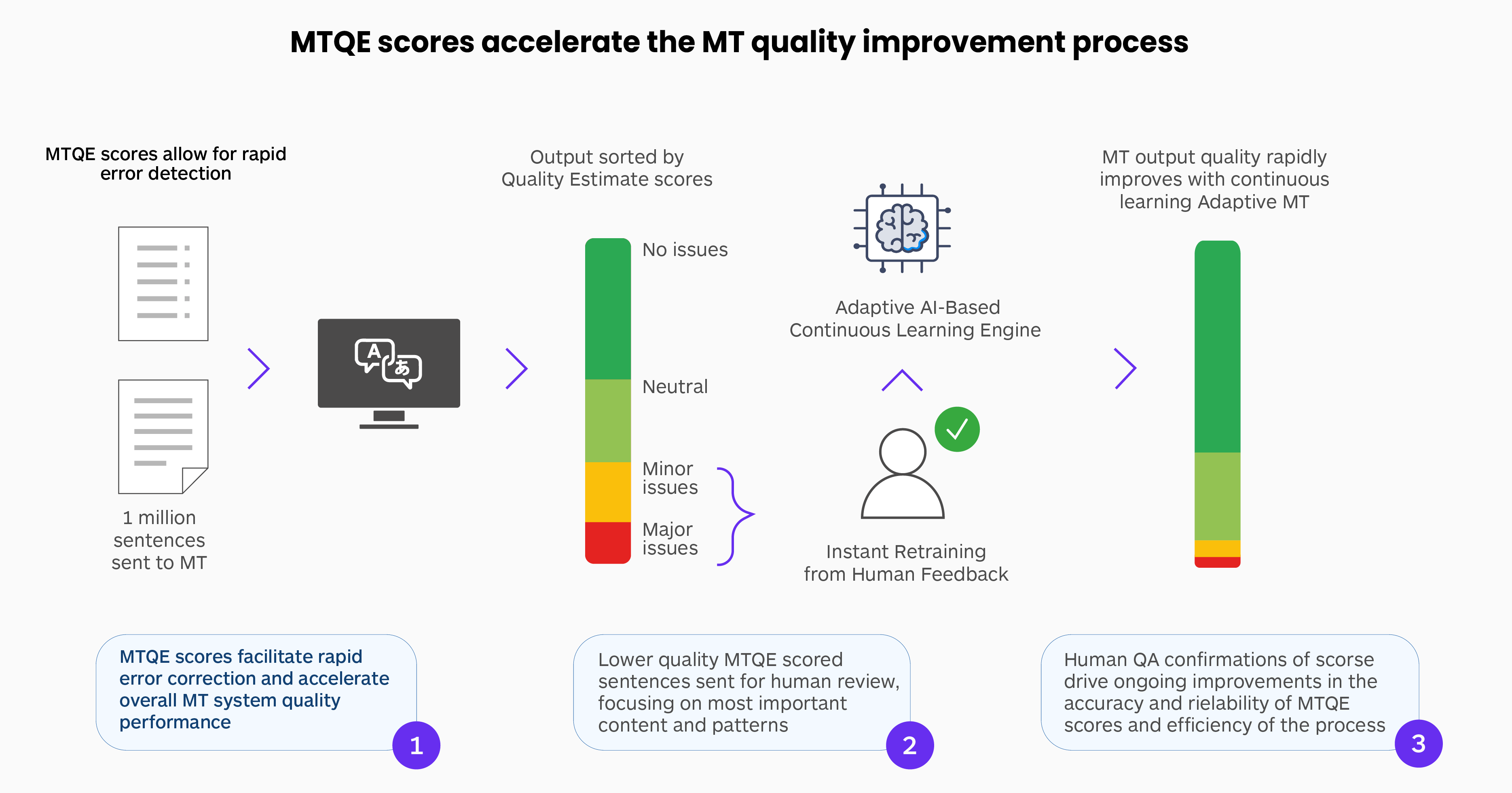

When a million sentences of customer-relevant content need to be published using MT, MTQE is a means to identify the ~10,000 sentences that most need human corrective attention to ensure that global customers receive acceptable quality across the board.

This informed identification of problems that need to be submitted for human attention is essential to allow for a more efficient allocation of resources and improved productivity. This process enables much more content to be published without risking brand reputation and ensuring that desired quality levels are achieved. In summary, MTQE is a useful risk management strategy as volumes climb.

Pairing content with lower MTQE scores into a workflow that connects a responsive, continuously learning adaptive MT system like ModernMT with expert human editors creates a powerful translation engine. This combination allows for handling large volumes of content while maintaining high translation quality.

When a responsive adaptive MT system is integrated with a robust MTQE system and a tightly connected human feedback loop, enterprises can significantly increase the volume of published multilingual content.

The conventional method, involving various vendors with different and distinct processes, is typically slow and prone to errors. However, this sluggish and inefficient method is frequently employed to enhance the quality of MT output, as shown below.


MTQE technology aims to pinpoint errors quickly and concentrate on minimizing the size of the data set requiring corrective feedback. The business goal centers on swiftly identifying and rectifying the most problematic segments.

Speed and guaranteed quality at scale are highly valued deliverables. Innovations that decrease the volume of data requiring review and reduce the risk of translation errors are crucial to the business mission.


The additional benefit of an adaptive rather than a generic MTQE process further extends the benefit of this technology by reducing the amount of content that needs careful review.

The traditional model of post-editing everything is now outdated.

The new approach entails translating everything and then only revising the worst and most erroneous parts to ensure an acceptable level of quality.

For example, if an initial review of 40% of the sentences with the lowest MTQE score using a generic MTQE model identifies 60% of the major problems in a corpus, using the adaptive QE model informed by customer data can result in the identification of 90% of the "major" translation problems in a corpus by focusing only on the 20% lowest scoring MTQE scores using the adaptive MTQE model. 

This innovation greatly enhances the overall efficiency. The chart below shows how a process that integrates adaptive MT, MTQE, and focused human-in-the-loop (HITL) work together to build a continuously improving translation production platform.


The capability to enhance the overall quality of translation in a large, published corpus by analyzing less data significantly boosts the efficiency and utility of automated translation. An improvement process based on Machine Translation Quality Estimation (MTQE) is a form of technological leverage that advantages extensive translation production.


The Evolving LLM Era and Potential Impact 

The emergence of Large Language Models (LLMs) has opened up thrilling new opportunities. However, there is also a significant number of vague and ill-defined claims of "using AI" by individuals with minimal experience in machine learning technologies and algorithms. The disparity between hype and reality is at an all-time high, with much of the excitement not living up to the practical requirements of real business use cases. Beyond concerns of data privacy, copyright, and the potential for misuse by malicious actors, issues of hallucinations and reliability persistently challenge the deployment of LLMs in production environments.

Enterprise users expect their IT infrastructure to consistently deliver reliable and predictable outcomes. However, this level of consistency is not currently easily achievable with LLM output. As the technology evolves, many believe that expert use of LLMs could significantly and positively impact current translation production processes.


Tuesday, May 30, 2023

Understanding Adaptive Machine Translation

Machine translation has been around for over 70 years and has made steady progress in tackling what many consider to be one of the most difficult challenges in computing and artificial intelligence. We have seen the approach to this challenge change and evolve, and MT has become much more widely used, especially since the advent of neural MT.

The deep learning neural net methods used in Neural MT have led to significant improvements in output quality, especially in terms of improved fluency, and have encouraged much wider use of machine translation in global business-driving applications.

While the momentum of Neural MT is well understood and recognized as a major advance in state-of-the-art (SOTA) machine translation, it is surprising that Adaptive MT has not had a greater impact.

This is especially true in the enterprise and professional translation market, where Adaptive MT can address specific and unique business needs much more effectively than alternatives. This paper explains why, even in the age of large language models, it remains a critical technology for global enterprises and professional users.

To better understand the value of Adaptive MT systems, it is useful to present a contrast to the typical generic static systems that most are familiar with.

The Typical Generic Static MT Engine


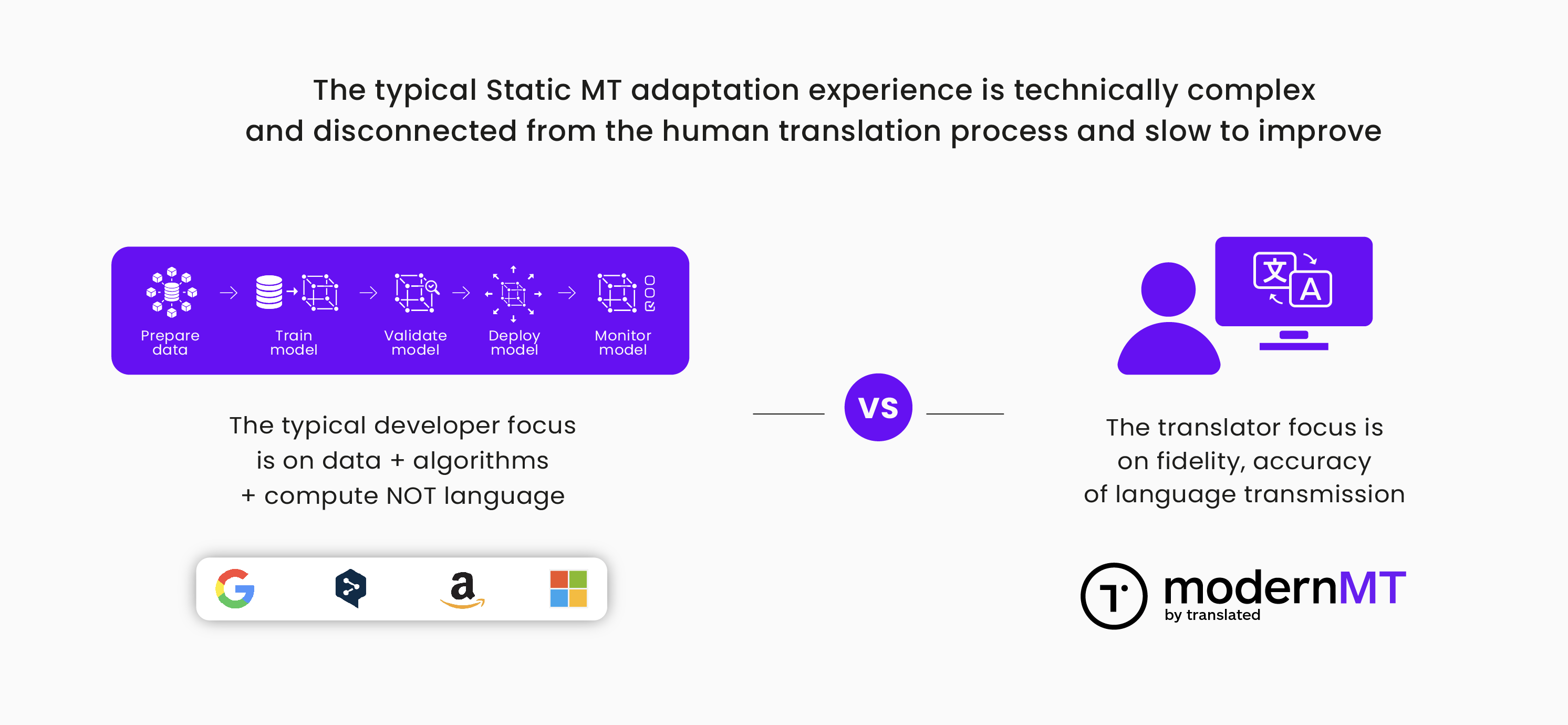
The MT engines that are generic and relatively static are intended for use by a large number of people. These engines do not alter how a phrase is translated until the next major update. Creating a generic baseline engine requires a considerable amount of effort in terms of cost, complexity, and data, which is why it is not done frequently. The diagram above displays the usual process involved in developing and producing a static engine.

A key characteristic of these static engines is that they do not evolve quickly because they require large new data sources to drive improvements, data that is not readily available, and thus generic static engines are typically updated no more than once a year.

On any given day, the major generic MT engine portals (Google, Microsoft, Baidu) allow hundreds of millions of people to translate material of interest. We have already reached the point where 99% or more of the translation done on the planet is done by computers, thanks to these generic engines.

In professional or business settings, the demands for using Machine Translation (MT) are quite particular. Generally, generic MT engines need to be tweaked and fine-tuned to cater to company- or project-specific language usage and terminology. This process of adjusting the MT engine to suit corporate requirements is known as customization or adaptation.

For example, if we consider the needs of IKEA, Pfizer, Airbnb, and Samsung, it is clear that they all have very different needs in terms of subject domain focus, style, and critical terminology and would be better served by enterprise-optimized MT than by a generic, one-size-fits-all MT solution.

Customization or adaptation of MT models to the correct terminology is necessary for successful outcomes with MT use in most enterprise or professional use settings.

The typical MT customization process using static engines is described below. The customization effort and process is a scaled-down version of the generic engine development process. Typically, it requires the collection and incorporation of enterprise translation memory relevant to the use case into the generic model via a scaled-down "training process."

This effort results in limited or coarse optimization if sufficient training data resources are available. The optimization is considered coarse because the training data available to perform the optimization is typically minuscule compared to the base data used in the generic engine. There is little value in training an engine with limited data as there would be no difference in performance from the generic baseline.

Thus, many attempts to use MT in professional settings face data scarcity problems. Limited data availability limits and reduces the potential impact of adaptation. To further complicate matters, it is usually necessary to build separate engines for each different use case, e.g., customer support, marketing, and legal would all be optimized separately.

Since many global enterprises have multiple product lines and businesses that cross multiple domains (TVs, semiconductors, PCs, home appliances) this will often result in a large number of MT engines needed to cover global business needs. As a result, it is often necessary to manage and maintain many MT engines. This management burden is often not understood at the outset when localization teams embark on their MT journey. This complexity also creates a lot of room for error and misalignment as data alignment can easily get out of sync over time.

Over time, many enterprise MT initiatives can be characterized by several problems that are common to users of these static MT systems. These problems are summarized below in order of frequency and importance:

  1. Ongoing scarcity of training data: Static models require a lot of data to drive improvements. There is little value in retraining a model until new or corrective data volumes reach critical levels.
  2. Tedious MTPE experience: Post-editors must repeatedly correct the same errors because these MT engines do not regularly improve, often leading to worker dissatisfaction.
  3. MT model management overhead and complexity: There are too many models to manage and maintain, which can lead to misalignment errors.
  4. Communication issues: Typically, between the MT development team and localization team members and translators, who have very different views of the overall process.
  5. Context insensitivity: Sentence- and document-level context is typically missing from these custom models.

From a technical standpoint, static MT systems often have a significant disparity between the encoding (training) and decoding (inference) stages of model deployment, resulting in a notable disconnect. Adaptive MT, on the other hand, aims to bridge the gap between the two phases of model creation (training) and deployment (inference), thus providing more effective support to expert users such as translators and linguists.

The Adaptive MT Experience

The static MT approach makes sense for large ad-supported portals where the majority (99%+) of the millions of users will use the MT systems without attempting modification or customization.

In contrast, the adaptive MT approach makes more sense for those enterprise and professional translators who almost always attempt to modify the behavior of the generic model to meet the specific and unique needs of a business use case.

ModernMT is an adaptive MT technology solution designed from the ground up to enable and encourage immediate and continuous adaptation to changing business needs. It is designed to support and enhance the professional translator's work process and increase translation leverage and productivity. This is the fundamental difference between an adaptive MT solution like ModernMT and static generic MT systems.


“Simplicity is the ultimate sophistication”

Leonardo da Vinci


While the ModernMT adaptive MT engine also has a basic generic engine underlying its capabilities, it is designed to work instantly with any available translation memory resources and to learn instantly from corrective linguistic feedback.

This is done without any user intervention or action to "train" the system. The user simply points to any available TM and it is used if it is relevant to the translation task at hand. Thus, while many struggle to use MT in an environment where use case requirements are constantly changing, this adaptive MT system uses memories, corrective feedback, and overall context gathered from both the memories and the overall document.


As the use of MT grows in the enterprise, the benefits of an adaptive MT infrastructure continue to accrue, as the management and maintenance of the many production MT systems require nothing more than the organization of TM assets and the provision of continuous corrective feedback to drive continuous improvements in system performance.

Thus, content creators and linguistically informed users can be the primary drivers of the ongoing system evolution. Because the underlying continuous improvement process is always active in the background, there is no need for any technology process management by these users. Translation issues that may arise in widespread use, can be quickly identified and corrected by linguists without the need for support from MT technology experts.

New use cases of large-scale deployments can be rapidly deployed by targeting human translation efforts on the most relevant and statistically present content. Adaptive MT technology allows for evolutionary approaches that ensure continuous improvement.


Independent market research points to some key factors that are often overlooked by those attempting to deploy MT in professional and enterprise environments. Surveys conducted by Common Sense Advisory and Nimdzi show that most LSPs/Enterprises struggle to deploy MT in production for three key reasons:

  1. Inability to produce MT output at the required quality levels. Most often due to a lack of training data needed for meaningful improvement.
  2. Inability to properly estimate the effort and cost of deploying MT in production.
  3. The ever-changing needs and requirements of different projects with static MT that cannot adapt easily to new requirements create a mismatch of skills, data, and competencies.

Given these difficulties, it is worth considering the key requirements for a production-ready MT system. Why do so many still fail with MT?

One reason for failure is that many LSPs and localization managers have used automated metrics to select the "best" MT system for their production needs without having any understanding of how MT engines improve and evolve. Automated MT quality metrics such as BLEU, Edit Distance, hLepor, and COMET are used to select the "best" MT systems for production work.

The scores can be helpful for MT system developers in enhancing and refining their systems. However, globalization managers who rely solely on this method to choose the "best" system may miss some noticeable limitations in selecting the most suitable MT system.

Ideally, the "best" MT system would be determined by a team of competent translators who would run directly relevant content through the MT system after establishing a structured and repeatable evaluation process. This is slow, expensive, and difficult, even if only a small sample of 250 sentences is evaluated.

Thus, automated measurements (metrics) that attempt to score translation adequacy, fluency, precision, and recall must often be used. They attempt to do what is best done by competent bilingual humans. These scoring methodologies are always an approximation of what a competent human assessment would determine, and can often be incorrect or misleading, especially with static Test Sets.

This approach of ranking different MT systems by scores based on opaque and possibly irrelevant reference test sets has several problems. These problems include:

  • These scores do not represent production performance.
  • These scores are typically obtained on static MT systems and do not capture a system's ability to improve.
  • The results are an OLD snapshot of a constantly changing scene. If you change the angle or focus, the results would change.
  • Small differences in scores are often meaningless, and most users would be hard-pressed to explain what these small numerical differences might mean.
  • The score is an approximate measure of system performance at a historical point in time and is generally not a reliable predictor of future performance.
  • These scores are unable to capture the dynamic evolution typical of an adaptive MT system.
  • Generic, static systems often score higher on these rankings initially but this does not reflect that they are much more difficult to tune and adapt to unique, company-specific requirements.

When choosing MT systems for production use, relying solely on score-based rankings can lead to suboptimal or even incorrect choices. This approach is often used because NMT system performance is difficult to understand and can be shrouded in mystery. However, automated metrics are not always reliable and should not be the only factor considered in making purchase decisions. Using scores to justify choices may be a "lazy buyer" strategy that fails to fully account for the complexity involved in selecting the best MT system for a given purpose.

But the failure of so many LSPs with MT technology suggests that this approach may not be the best way forward to achieve production-ready and production-grade MT technology. So what criteria are more relevant in the context of identifying production-grade MT technology? The following criteria are much more likely to lead to technology choices that make long-term sense. For example:

  • The speed with which an MT system can be tuned and adapted to unique corporate content. Systems that require complex training efforts by technology specialists will slow the globalization team’s responsiveness.
  • The ease with which the system can be adapted to unique corporate needs The need to have expensive consulting resources or dedicated MT technology staff on hand and ready to go greatly reduces the agility and responsiveness of the globalization team.
  • An automated and robust MT model improvement process as corrective feedback and improved data resources are brought to bear.
  • The complexity of MT system management increases exponentially when multiple vendors are used as they may have different maintenance and optimization procedures. This suggests that it is better to focus on one or two partners and build expertise through deep engagement.
  • The ability of a system to enable startup work even if little or no data is available.
  • straightforward process to correct any problematic or egregious translation errors. Many large static systems need large volumes of correction data to override such errors.
  • The availability of expert resources to manage specialized enterprise use cases and trained human resources (linguists) to help prime and prepare MT systems for large-scale deployment.

It is now common knowledge that machine learning-based AI systems are only as good as the data they use. One of the keys to long-term success with MT is to build a virtuous data collection system that refines MT performance and ensures continuous improvement. The existence of such a system would encourage more widespread adoption and enable the enterprise to become multilingual at scale. This would allow the enterprise to break down the barrier of language as a barrier to global business success.

One should not assume that all adaptive MT systems follow the same technological approach. In fact, real-time, in-context adaptation can be achieved through various architectural methods. Upon closer examination of other adaptive MT solutions, it is apparent that dynamic adaptation can be accomplished using different technological strategies. However, as more buyers come to realize that the responsiveness of the MT system holds greater importance than a static COMET score on a random test set, the evaluation strategies will evolve. It will be more beneficial to assess which systems can adapt most effortlessly with minimal effort.

The ModernMT approach to adaptation is to bring the encoding and decoding phases of model deployment much closer together, allowing dynamic and active human-in-the-loop corrective feedback, that is not so different from the in-context corrections and prompt modifications we are seeing with large language models.

It is possible that in the future, as Large Language Models (LLMs) become more cost-effective, scalable, secure, and controllable, they could be utilized to enhance SOTA adaptive MT models. This could improve both core translation quality and output fluency, either as stand-alone solutions or more likely as hybrid models that work with MT purpose-focused models that are yet to come.

Although LLMs have demonstrated their effectiveness in certain high-resource languages, their performance in lower-resource languages is notably poor according to initial evaluations. This outcome is not surprising, given that LLMs are not specifically tailored for translation tasks. The challenge lies in the fact that LLMs rely on extensive data caches for each language, and the significant data volumes required for improvement are often difficult to locate. Therefore, resolving this issue will not be a quick or simple process.

In contrast, ModernMT just announced support for 200 languages that can all immediately benefit from the continuous improvement infrastructure that underlies the technology, and begin the steady quality improvement process that is described in this article.

It has become evident that real-time systems that can enhance performance and swiftly respond to informed feedback from experts are highly favored to tackle the task of large-scale automated language translation.

Once customers have experienced the advantages of dynamic adaptive systems, they are unlikely to revert to the complexities, inconveniences, and slowly improving output quality of batch-trained static MT systems.