Pages

Showing posts with label global business. Show all posts

Monday, June 27, 2022

The Translation Engine Supporting Global CX

What do we mean when we use the term “customer experience” or CX?

CX is the sum of impressions associated with a brand for a particular customer. CX is built over different stages of the customer journey and encompasses all the interactions the customer has with the brand. It may include both positive and negative feelings, incidents, and expectations.

Customer experience can be linked with the direct experience and overall perceptions of:

  • Convenience
  • Responsiveness
  • Speed
  • Quality
  • Aesthetics
  • Value alignment
  • Pleasure
  • Ease of access
  • Omnichannel capabilities

While CX is sometimes equated with making more information available online, with customer surveys, or increasing digitization of customer interactions, it is more. Much more.

Commonly used snapshot measurements of CX like CSAT (Customer satisfaction) and NPS (Net promoter score) give executives a sense of it, but we should understand that true CX "goodwill" is not so easily measured and put on KPI dashboards.

CX is a continuous journey that begins with the first contact or impression from a brand or enterprise and continues for the life of the customer engagement.  


Why CX Matters

As more of the world gets more accustomed to a digital-first buyer journey, especially with the challenges created by the pandemic, companies have focused on more engagement with their customers via digital channels. In an increasingly digital world where products and services are scrutinized in the court of public opinion, customer experience (CX) is king.

What truly makes for a good experience? Speed. Convenience. Consistency. Friendliness. And one big connector: human touch - that is, creating real connections by making technology feel more human, and also giving employees what they need to create better customer experiences.

People are increasingly more loyal to the retailers, products, brands, and devices that consistently provide exceptional value with minimum friction or stress. Value is created from the complete CX.

Every interaction is a direct reflection of the company’s brand. Convenience—seamless transition from tablet to smartphone to desktop to human—is a baseline expectation.

The benefits of providing superior CX are increasingly clear:

  • Consumers will pay a 16% price premium for a great customer experience AND are more likely to be loyal to the brand. – PwC
  • Among US consumers, 63% say they’d share more information with a company that offers a great experience. - PwC
  • Customer Experience leaders grow revenue faster than CX laggards, drive higher brand preference, and can charge more for their products.” – Forrester’s Rick Parish.
  • #1 – By 2021, customer experience will overtake price and product as the key brand differentiatorWalker
  • Consumers are 3.7x more likely to recommend an organization after a positive customer experience. - Qualtrics
  • Maximizing satisfaction in the customer journey can lift revenues by up to 15% and lower the cost of serving customers by up to 20%. - McKinsey

The consequences of providing what is regarded as inferior CX are also quite clear:

  • One in three consumers says they will walk away from a brand they love after just one bad experience. This figure is even higher in Latin America, at 49%. – PwC
  • 92% would completely abandon a company after 2 or 3 negative experiences. - PwC

Thus, we see increased attention on what it means to get CX right. Done right, technology can help companies create phenomenal customer experiences and reap the resulting benefits: however, a large majority of the top-performing companies report paying close attention to the human experience around digital and tech.

Companies won’t be able to solve their customer experience problems with technology alone—it’s just the enabler. Employees also need to be empowered, supported, and allowed to make mistakes, and a majority of customers around the world report that a positive experience with a brand is more important than advertising.

Nearly 80% of American consumers point to speed, convenience, knowledgeable help, and friendly service as the most important elements of a positive customer experience. It is important to note that it is the combination of technology working together with competent, friendly humans that matters.

According to a PwC survey, only 49% of US consumers say companies provide a good customer experience today. So, there is much room for improvement.

Cultivating a customer-centric culture is a critical component of building the brand CX. This calls for targeted efforts to build employee capabilities across the enterprise. Truly customer-centric companies train employees at every level of the organization and in every function, from sales to accounting, to make sure they understand the role they play in maximizing the customer’s experience.

The Pandemic Impact

The pandemic has accelerated the steady growth trend in digital interactions with customers, and many believe that the opportunities and paradigm shifts that have emerged will persevere postcrisis.

The increase in digitization has affected both the B2C and the B2B market. Consumers who grow accustomed to superior B2C digital CX also expect the same kind of user experience in B2B scenarios. The rate of change in digitization was dramatically influenced by the pandemic. McKinsey estimates that the pandemic impact across the globe was to accelerate digitization by an average of seven years.


The pandemic drove B2B customer behaviors to begin to shift dramatically, favoring video conference interactions with sales reps over in-person meetings. eCommerce marketplaces have emerged as a preferred mode of interaction over direct sales rep interactions in many B2B settings in the last year (2021).

The Key Requirements to Enhance CX

Much of the customer journey today involves a buyer interacting independently with content related to the product of interest. CX leaders today increasingly understand that on digital platforms, useful, and relevant content is how this journey is enhanced and improved.

Understanding and providing relevant content that matters to the customer is a prerequisite for providing superior DX and CX and enabling customer success.

Customers want personalized, relevant information to guide their purchase decisions, and also want self-service support content to be able to be as independent as possible after they buy a product.

Thus, brands need to provide much more content, both in terms of ongoing volume and relevance, than they traditionally have provided.

Gartner and other analysts have identified that the ability of a buyer to access and gather relevant information related to a purchase decision independently is a critical requirement of the modern buyer in both B2C and B2B scenarios.

There is now also an acknowledgment that customer reviews of unique and personal CX experiences of previous customers are very important to new customers who are in the final stages of their purchase evaluations.

Customers across industries have shown a strong preference to see authentic, validated reviews of shared independent customer experiences that may inform a buyer of potential problems before purchase, and also identify possible support issues after the purchase.

In many eCommerce marketplaces, customer reviews can be THE most influential driver of purchase behavior.

The transparency and trustworthiness of these reviews are often more impactful to a buyer than much of the organization’s own product marketing content.

“Customers spend much more time doing research online -- 27% of the overall purchase evaluation and research [time]. Independent online learning represents the single largest category of time-spend across the entire purchase journey.”
-- Gartner

 Developing better CX also involves building better collaboration and knowledge and data sharing models across the organization.

Customer problems are not merely sales issues. The root cause of customer problems often runs across departments, and developing structural solutions, and improving the CX requires collaboration, cooperation, and knowledge sharing across the organization.

Experts have noted that leaders develop “digital agility”, that enables cross-function collaboration focused on mapping and optimizing customer journeys which in turn leads to gathering the right data to drive predictive analytics to enhance and improve CX.
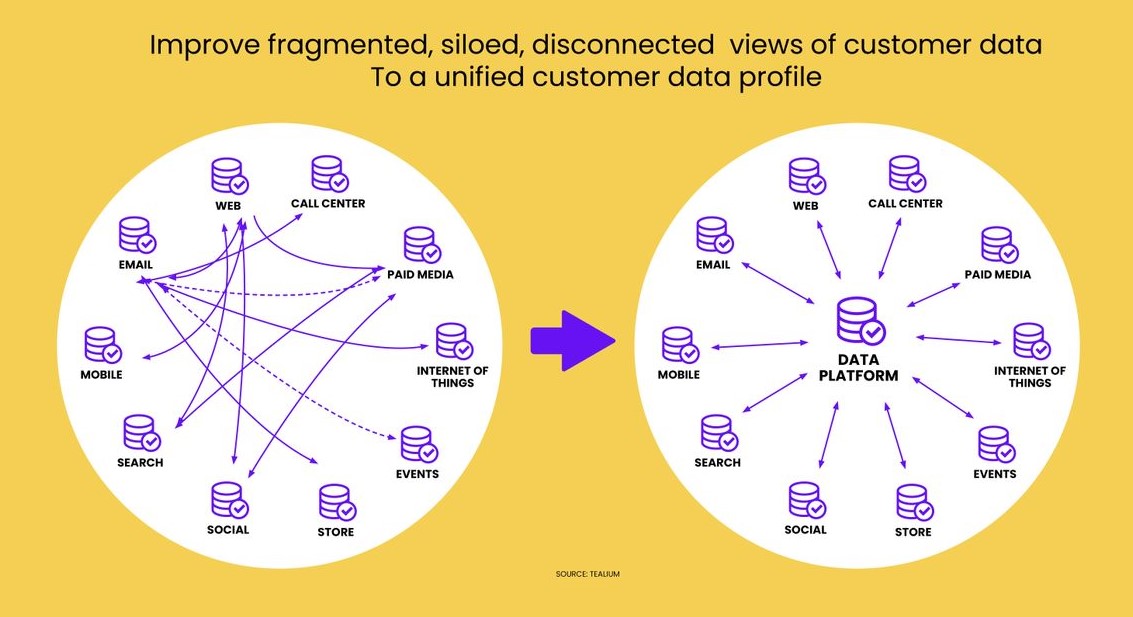

While technology is a critical enabling tool for improving CX at a structural level, delivering better CX also requires a significant investment in the employee experience, empowerment, training, and a cultural reset to develop customer-centric and customer-friendly solutions. Alert, motivated employees are needed to identify and reduce the many friction points that exist in most organizations.

Some experts say that the human development efforts are as critical as the core-technology foundations, and the understanding of the buyer journey.

Reducing friction for customers requires that the organization empower employees to focus on higher customer satisfaction, which can only happen in a supportive, and empowered culture of forgiveness that encourages learning.

This may require new ways of working, with more focus on the employee experience, and a sophisticated view of the human-machine interactions, to ensure that the foundational technology supports and enhances BOTH the customer and the employee experience.

Good customer experience leaves consumers feeling heard, seen, and appreciated, and this is most often based on human interactions.

Automation matters, but making sure customers can reach a human when one is needed is often critical. Additionally, automated solutions should “learn” from human interactions so the automated experiences also improve.


The Translation Implications of CX for the Global Enterprise

In a nutshell, the implications include:

  • New types of content
  • Both internal and external content
  • More volume at varying levels of quality
  • Use of new tools beyond the capabilities of current TMS systems and generic MT
  • More dynamic, real-time, and integrated into core IT infrastructure.

Language translation in the enterprise is most often managed by localization departments that focus on relatively static content.

Even though most localization departments have been seeing a steady increase in demand for translation, traditionally this department has focused on getting critical customer-facing documentation, marketing materials, and surface-level web content translated into the languages relevant to target international markets.

Much of the focus of localization has been on what is deemed mandatory content. This includes packaging material, user documentation, marketing collateral, and software interfaces and manuals. The top-level content of the website might also be translated, but much of the product, support, and deep marketing content is beyond the scope and budget of most. Even for the largest organizations, the translation volumes rarely exceed a million source words a month.

With a CX focus, the picture changes drastically. CX is much more focused on dynamic, fast-flowing, continuously changing, real-time content. It is also broader and deeper in terms of content coverage than is typical for localization. To provide the global customer the same CX as a US customer, significantly more volumes of content need to be translated.

Much of this content is unstructured and related to communication, broader, deeper customer support, listening to customer feedback, customer reviews, internal communications, knowledge sharing between globally dispersed internal workgroups, social media analysis, and much more.

Thus, in terms of monthly word volume, this can often mean that hundreds of millions of words or even billions of words need to be translated to provide the same buyer journey to global customers.

Given the sheer volume of content that has to be translated by machine, also requires that it is increasingly served to customers without comprehensive PEMT or even any editing.

The translation production mode used for a million words a month does not make sense for the production scenario which requires a billion words a month.


Localization processes often use a Translate-Edit-Proof (TEP) approach where all the translated content goes through one or more levels of human processing and refinement. Research shows that there is limited use of MT by localization-focused teams, and on average, in 2021, the top 170 LSPs use MT in less than 15% of their customer translation production workload.

Also, generally, the use of MT post-editing (PEMT) focuses on virtually all the MT content, and the motivation for any limited use of MT is primarily for efficiency reasons (cheaper and faster).

Global CX cannot be improved without using much more MT. MT acceptance is increasing because of the combined impact of the following:

  • Market leaders show the benefit of translating CX-related content with sophisticated and expert use of MT,
  • Human linguist evaluations show that MT output is often indiscernible from human translation,
  • Direct customer feedback on the usefulness of MT content suggests that customers are willing to accept “imperfect” MT to get broader content access and faster response,
  • To ensure that the global CX is equal across languages to minimize revenue loss,
  • The increasing importance of community and customer-created content (UGC),
  • The growing importance of self-service for most digital-first customers,
  • Emerging fast-growing markets in Africa, the Middle East, and South Asia will need more MT.

The inconsistent translation practices across languages result in sub-optimal CX for customers of less-translated languages who prefer to see content in their own language.  This in turn can dramatically affect revenue from underserved global markets. 


Since CX content volumes involve a steady flow of hundreds of millions of new words, not only is specialized MT technology necessary but there also needs to be a close and tightly integrated feedback loop with linguists who provide corrective feedback to enable continuous improvement of the MT output quality.

The optimal translation production mode for CX scenarios needs highly responsive MT that continues to evolve in quality with ongoing feedback. As it is simply impossible to deliver a billion words at TEP quality, organizations must analyze the content and determine what the right mix of MT and human input is for different kinds of content. The higher the volumes the greater the need for automated translation.  


Thus, MT output for internal communications, user reviews (UGC), or social media analysis will have less human oversight, but customer support content can get more human input to ensure the MT output quality is higher for knowledge base and technical FAQ material.

The translation production process in the current "digital-first" reality means that digital content and software interfaces are in continuous update and evolution cycles.  Thus, the translation production process frequently involves tens of thousands of small (50 -100 words) translation tasks per month and is often called “continuous localization”. The two most widely used tools are translation memory (TM) and translation management systems (TMS) which are important to enable this kind of localization at the required scale.

However, while TM is valuable to the MT development process and is “AI-ready”, the same cannot be said for TMS systems in the CX translation-needs context.

TMS systems are instrumental in working within the structured localization context, which needs the translation workflow and project management, and monitoring capabilities that typical localization content requires.

Current TMS systems, however, are not the optimal tool for the less structured, more varied, faster-flowing, CX content. TMS systems are optimized for relatively low-volume high-touch, project-management-heavy, localization workflows. They were simply not designed to handle the sheer volume of UGC, and real-time dynamic communications-related content around CX, that needs little or none of the core TMS functionality.

As translation focus moves to service high-volume, fast-flowing social media, UGC, real-time chat, email, and collaboration around knowledge content, it makes much more sense for the systems containing this content to connect directly into adaptive MT with integrated corrective feedback (learn-fast, improve quickly) systems, or data interchange layers that are built for 100X+ the scale of most current TMS systems.

Both automated and human translation services need to connect to Enterprise CX infrastructure much more seamlessly, dynamically & directly to deliver purpose-ready translation where needed.


This explains the increasing interest in concepts like “LanguageOps”, “TranslationOS”,  "Language Platforms" and the notion of a Translation Layer for the Enterprise OS.

As translation penetrates deeper into the core IT infrastructure of the enterprise, there are a growing set of use-cases that have little or no need for the core functionality of TMS systems, especially for CX and eCommerce-related content.

Adaptive MT-connected TM tools are still valuable in this greatly expanded translation context, as they provide a means to input linguistic feedback and drive improvements in MT output quality over time. It can only be done over time because there is too much content.

This is easily understood in the context of content seen on a multilingual eCommerce site. The content on any given page is not treated the same way when considering translation production options. Many eCommerce sites will have millions of such listings. There is always a small volume of critical content that needs to go through the standard localization process, but the large bulk of the volume is better handled by different human-machine mixes that aim to produce translations that are fit for purpose and enhance the CX, and facilitate customer evaluation and understanding.
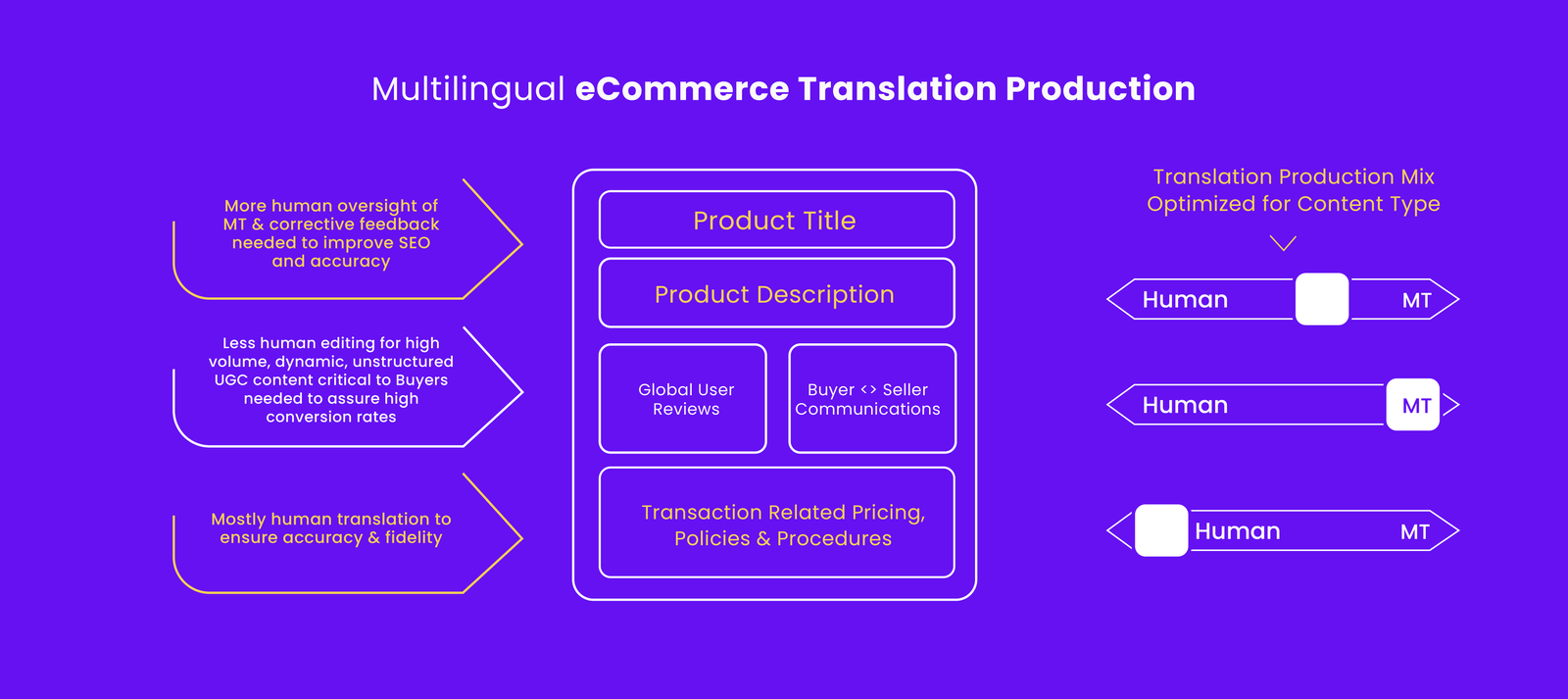
Translation in the Age of CX is different because it is more dynamic, more varied in quality, and more real-time and instantaneous. The key attributes can be summarized below:
  • Scales from millions to billions of words a month
  • Integrated into critical communication, collaboration, and customer data platform infrastructure
  • Able to vary production modes for varying translation quality needs
  • Enables pervasive but differently optimized translation capabilities across the enterprise
  • Goes beyond the capabilities of any of the currently available TMS systems

Tuesday, December 25, 2018

The Global eCommerce Opportunity Enabled by MT

The holiday season around the world today is often characterized by special holiday shopping events like Black Friday and Cyber Monday. These special promotional events generate peak shopping activity and are now increasingly becoming global events. They are also increasingly becoming a digital and online commerce phenomenon. This is especially true in the B2C markets but is also now often true in the B2B markets.

The numbers are in, and the most recent data is quite telling. The biggest U.S. retail shopping holiday of the year – from Thanksgiving Day to Black Friday to Cyber Monday, plus Small Business Saturday and Super Sunday – generated $24.2 billion in online revenues. And that figure is far below Alibaba’s 11.11 Global Shopping Festival, which in 2018 reached $30.8 billion – in just 24 hours.


When we look at the penetration of eCommerce in the U.S. retail market, we see that, as disruptive as it has been, it is still only around 10% of the total American retail market. According to Andreessen Horowitz, this digital transformation has just begun, and it will continue to gather momentum and spread to other sectors over the coming years.

The Buyer’s Experience Affects eCommerce Success


Success in online business is increasingly driven by careful and continued attention to providing a good overall customer experience throughout the buyer journey. Customers want relevant information to guide their purchase decisions and allow them to be as independent as possible after they buy a product. This means sellers now need to provide much more content than they traditionally have.

Much of the customer journey today involves a buyer interacting independently with content related to the product of interest, and digital leaders understand that understanding the customer and providing content that really matters to them is a pre-requisite for digital transformation success.

B2B Buying Today is Omnichannel


In a recent study focused on B2B digital buying behavior that was presented at a recent Gartner conference, Brent Adamson pointed out that “Customers spend much more time doing research online – 27% of the overall purchase evaluation and research [time]. Independent online learning represents the single largest category of time-spend across the entire purchase journey.”

The proportion of time 750 surveyed customers making a large B2B purchase spent working directly with salespeople – both in person and online – was just 17% of their total purchase research and evaluation process time. This fractional time is further diluted when you spread this total sales person contact time across three or more vendors that are typically involved in a B2B purchase evaluation.

The research made evident that a huge portion of a sellers’ contact with customers happens through digital content, rather than in-person. This means that any B2B supplier without a coherent digital marketing strategy specifically designed to help buyers through the buyer journey will fall rapidly behind those who do.

The study also found that just because in-person contact begins, it doesn’t mean that online contact ends. Even after engaging suppliers’ sales reps in direct in-person conversations, customers simultaneously continue their digital buying journey, making use of both human and digital buying channels simultaneously.

Relevant Local Content Drives Online Engagement


Today it is very clear to digitally-savvy executives that providing content relevant to the buyer journey really matters and is a key factor in enabling digital online success. A separate research study by Forrester uncovered the following key findings:
  • Product information is more important to the customer experience than any other type of information, including sales and marketing content.
  • 82% of companies agree that content plays a critical role in achieving top-level business objectives.
  • Companies lack the global tools and processes critical to delivering a continuous customer journey but are increasingly beginning to realize the importance of this.
  • Many companies today struggle to handle the growing scale and pace of content demands.
A digital online platform does enable an enterprise to establish a global presence very quickly. However, research suggests that local-language content is critically needed to drive successful international business outcomes. The global customer requires all the same content that a US customer would in their own buying journey.

Machine Translation Facilitates Multilingual Content Creation


This requirement for providing so much multilingual content presents a significant translation challenge for any enterprise that seeks to build momentum in new international markets. To address this challenge, eCommerce giants like eBay, Amazon, and Alibaba are among the largest users of machine translation in the world today. There is simply too much content needs to be multilingual to do this with traditional localization methods.

However, even with MT, the translation challenge is significant and requires deep expertise and competence to address. The skills needed to do this in an efficient and cost-effective manner are not easily acquired, and many B2B sellers are beginning to realize that they do not have these skill in-house and could not effectively develop them in a timely manner.

Expansion Opportunities in Foreign Markets


The projected future growth of eCommerce activity across the world suggests that the opportunity in non-English speaking markets is substantial, and any enterprise with aspirations to lead – or even participate – in the global market will need to make huge volumes of relevant content available to support their customers in these markets.

When we look at eCommerce penetration across the globe, we see that the U.S. is in the middle of the pack in terms of broad implementation. The leaders are the APAC countries, with China and South Korea having particularly strong momentum as shown below. You can see more details about the global eCommerce landscape in the SDL MT in eCommerce eBook.


The chart below, also from Andreessen Horowitz shows the shift in global spending power and suggests the need for an increasing focus on APAC and other regions outside of the US and Europe. The recent evidence of the power of eCommerce in China shows that these trends are already real today and are gathering momentum.

The Shifting Global Market Opportunity


To participate successfully in this new global opportunity, digital leaders must expand their online digital footprint and offer substantial amounts of relevant content in the target market language in order to provide an optimal local B2C and B2B buyer journey. 

As Andreesen points out, the digital disruption caused by eCommerce has only just begun and the data suggests that the market opportunity is substantially greater for those who have a global perspective. SDL's MT in eCommerce eBook provides further details on how a digitally-savvy enterprise can handle the new global eCommerce content requirements in order to partake in the $40 trillion global eCommerce opportunity.


This is a slightly updated post that has been already published on the SDL site


Happy Holidays to all.  

May your holiday season be blessed and peaceful.  


Click here to find the SDL eBook on MT and eCommerce.


Thursday, September 28, 2017

Enabling Authenticity in Global Branding

This is a guest post by Aaron Schliem, who writes on  fundamental globalization questions. Most of the agencies in the translation industry are involved in brokering human translation services, which is increasingly under price pressure, because most agencies add very little value to the production process beyond brokered project management, and we also see that MT is getting "good enough" to solve many enterprise needs to communicate multilingually. However, value is added by humans who understand the bigger picture, and tune business content creation processes to improve the overall customer experience regardless of locale and language.

As all major enterprises today become more global, both in their internal workforce composition, and their primary market outlook, new, more culturally informed approaches are needed. The problem is not just at agencies, as Aaron says:
Global business presently operates within an overly simplistic paradigm that assumes translation of product and marketing content is sufficient to be successful in the global economy. We believe that the localization industry has become consumed with what amounts to “computer-enabled translation,” content to simply move content along a conveyor belt to deliver words to market. Both agencies and the corporate buyers of their services typically fail to focus the human side of globalization.
 I believe this kind of broader and more global human focus will be part of the makeup of the best agencies in future, and is already part of the culture and DNA at truly global enterprises.

As an aside, but somewhat related to changing trends, there is a lot more content out there that really matters, to drive global revenue, and is needed to get involved in many different customer related conversations that are key to international business success. I saw in a recent interview with the Moravia CEO, Tomas Kratochvil, stated that “We have 80% of content already going through machine translation. The number of words we are able to process for our customers is much higher than it used to be in the past,” he points out. “We’ve changed the way we do business from close to zero machine-translated words to 70-80% of words which are machine-translated.” Slator characterizes the recent past of Moravia as a "quiet rise and strategic shift" and apparently they are a 160M company today. Probably 2X to 3X what they were 5 years ago.

SDL is at about $365M in revenue (with a weak Brexit Pound) and are the most engaged with MT 99.5%  of words they process coming from MT (100M HT and 20B MT per month), which also means they are really engaged in a much broader range of customer conversations that define the global customer experience. Both these companies have grown significantly over 5 years. 

Now contrast this to Lionbridge which has hovered around $500M for 5-10 years. Rory Cowan of Lionbridge recently said that "Machine translation has been the classic dark horse, of course, waiting for its hour of glory."  (Wake up, dude!) The cost for missing the boat in competitive businesses is to lose market share e.g. LIOX. I am going to bet that the 5 year success metrics for both Moravia and SDL were significantly better than what we have seen with Lionbridge. MT is only a small part of this of course, but it was strategic many years ago for those who were clued in. I am going to bet using it well will become an even more important element over the next five years.


-----=======-----

Let me describe for you what global branding often looks like in US companies. The self-assured marketing team typically develops a brand strategy that is unconsciously steeped in the culture that prevails at headquarters. The well-meaning team makes decisions and assumptions about what people value, how they behave, what their history is, what they may find compelling, all the while not realizing that they are silently defining “people” as “Americans.” Once the team at headquarters feels the brand is properly characterized, guidelines, story lines, talking points and imagery are developed to facilitate communication of the brand identity and strategy to staff and consumers. Downstream content and assets are translated into other with the intention of bring teams from diverse geographies into the fold. After translation, headquarters might reach out to local market colleagues and ask them to review the translations. But not even that level of engagement with international colleagues is a sure thing. The bottom line is that, as with most areas of business, branding teams approach globalization as an after-thought that can be addressed through translation once the company vision is set – from headquarters.

At its core this approach makes a rather righteous assumption about the global dominance of US business and consumer culture. Everyone loves America, after all, right? It’s easy to think that people all over the world are so used to “buying” American culture that no additional efforts to connect need to be undertaken. This is reinforced by the fact sometimes it is, in fact, the very Americanness of the brand that people are buying. According to the Wall Street Journal, Cadillac sales are up 23% globally this year (through July 2017), with year-to-date sales in China jumping 69% relative to the same 7-month period in 2016. Why? A Shanghainese Cadillac owner indicated that his car sets him apart and “represents American heritage.” You see the ubiquity of American culture among the cosmopolitan elite in Europe in daily conversation where, whether you are speaking Spanish, French or German, the word “cool” has become cool.

Given the dominance of the United States in the global economy since WWII, complacency is an easy trap to fall into. It’s easy to think that if you are selling internationally and increasing your sales year-over-year, the current approach must be working just fine. But this sort of thinking dramatically over simplified the issue. Just because a company is growing internationally doesn’t mean it could not be growing much more quickly internationally or that the growth might not be longer-lasting if more nuanced global strategic thinking were applied. Implicit in this over-simplification is the idea, made famous in the film Field of Dreams, that if we just “build it” then naturally “they will come.” However, this reeks of American over-confidence.

In their defense, I don’t think that branding professionals are consciously putting on airs. The lack of vision results from lack of experience in global settings. Living in a large and diverse country like the United States, it’s easy to live in a bubble. Even when Americans put on their explorer hats and plan vacation adventures designed to broaden our horizons, we tend to focus on relatively less-expensive domestic travel. Why visit Orleans when you have New Orleans in your backyard? OK, maybe a bad example – New Orleans is pretty objectively awesome regardless of how you look at it – but you see my point. And in a country where work is king, paid time off is scarce, and only 36% of citizen have valid passports, one can understand how Americans end up having fewer international experiences. Americans live in a massive cultural silo so it is logical that our approach to branding would have similar dimensions, or lack thereof.


 Nonetheless, developing a global brand strategy while living in self-imposed cultural isolation is problematic. When the approach to global branding becomes mono-cultural, it is more difficult to apply in new markets. In not leveraging ground-floor observations from a variety of cultures to assemble an inclusive and authentic brand vision, the approach reinforces a wide-spread skepticism and resentment of American cultural arrogance. It plays into the common view that American companies are brute force neoimperialists, self-aggrandizing egomaniac, or “my way or the highway” managers who could care less how the rest of the world functions. Developing a cohesive global brand is difficult in the best of circumstances. This sort of monolithic thinking does little to set the company up for success. On the contrary, it alienates those who are best positioned to help the company to be successful.

Why does it matter?

Modern business is global by definition. Being global it is not an optional marketing strategy that can be employed down the road once domestic growth has tapped out. According to the UN Conference on Trade and Development’s 2017 World Investment Report, over the past 25 years the top 100 multinational enterprises (MNEs) have seen the majority of their sales, assets and employees shift to foreign markets. The shift is even more dramatic when you look only at companies from the digital economy, which has traditionally formed the backbone of the globalization industry. Why does this matter? Well, first off, no global business is going to be successful unless its employees understand and value the brand. If most of your employees do not reside within the headquarters culture, extra effort is required to ensure that the work of foreign employees will support and strengthen the brand. And if most of your customers are foreign, your brand strategy needs to be broad enough to include a range of cultural realities.


Tips for building globally-enabled brands


  1. Explore your own cultural biases: The number one thing you can do to improve your global brand is to start by examining your own cultural baggage. To connect with people and ideas that are outside our cultural frame of reference, we first need to be break free from the assumptions we make, day in and day out, without even realizing we are doing so. A great way to break biases is to engage in cross-cultural communications training (hint, hint – yes, Idiosynch offers this). Even something as simple as attempting to learn a new language forces us to move outside of our rote thinking. If taking a class is not feasible, we can extend culturally by simple acts in everyday life. Take a moment to talk with someone from a different culture, whether they are your doctor, your grocery bagger or the barista at your local café. Exploring the world begins with exploring people and if we are willing to open our eyes, there are a surprising number of opportunities to grow our cultural knowledge in our local communities. Often it is not hard to see our own biases once we have a little perspective. Getting perspective, however, requires conscious effort and a commitment to honest and humble self-examination.
  2. Open your ears to global voices: You would be surprised how much global experience exists on even small domestic teams. Because we are so used to thinking and acting from within our bubbles we rarely ask ourselves and our colleagues about the experiences that have forced us to question our cultural assumptions. One need not have travelled the world to have had such experiences. We have them every day with our neighbors and friends. Sharing our diverse experiences primes our ability to think outside of our own bubble. If your organization is already global, a powerful approach is to engage with local champions from a variety of disciplines in the company. By including diverse voices, we can learn to understand and codify brand identity in ways that drill down to the core message, retaining a common cultural denominator that does not preclude any single culture from participating.
  3. Universal but flexible: Brands cannot be infinitely malleable. After all, each company needs a level of brand consistency across all markets. That said, the Apples of the world, with their one-size-fits-all approach, are rare and exceedingly difficult to create. With global branding we want to develop a core universal brand identity, a basic set of values and emotional connections we hope to make in all markets, while retaining enough flexibility to adapt to local cultural realities. Let’s think about brand in terms of storytelling. The global brand can be quite specific about how it defines the “moral of the story,” or, simply put, the brand message. The moral of the story is what matters and needs to be conveyed in every market. By communicating the moral without prescribing the characters, plot, setting, etc, we can empower local teams to tell a wider range of stories, tailored to local cultural realities.
  4. Customization guidelines: A strong global branding strategy that will require adaptation by region or market. But allowing local teams to adapt brand identity willy-nilly is a surefire way to lose control. Through communication and coordination with local-market teams and by making use of cultural consultants to provide heuristic analysis, a branding team can develop market-specific guidelines (linguistic, visual, value mapping, etc.) that allow local market teams to bring their superior cultural knowledge to bear while ensuring an adequate level of control and transparency for headquarters.
  5. Authenticity and values: Brands are striving for authenticity and emotional connections with consumers. But to be authentic, you need to know what authenticity looks like in other cultures. To build a brand identity without viewing it through diverse lenses of cultural authenticity is naïve at best and potentially devastating. Not knowing what cultural myths one is conjuring, what history one is evoking, what references to art or pop culture one is unwittingly making, is the surest way to alienate consumers. For not only does the brand miss an opportunity to connect; it is damaging its chances of ever connecting. Americans are less accustomed to this dynamic because many of the most powerful brands are in fact American. But ill-conceived branding is common in other markets. Both the American perpetrators and the local recipients tend to laugh off these branding faux pas, but at the end of the day, the brand that fails to demonstrate authenticity in culturally specific ways is bound to be perceived as out of touch or worse, disrespectful.
  6. Brand is culture: Culture, ideology, history and politics inform and affect the way we build brands, how we perceive brand meaning and what values are ultimately targeted. With the emergence of earned content (user-generated content) as a key conduit for demonstrating authenticity, the dance between culture and brand is now happening in real time and it can be difficult to tell who is leading and who is following. Brand is understood and experienced by consumers through their cultural lens. But culture itself can be observed and understood through brand as consumers assert their voice and equal role in the dance. We are emerging into an era where brand strength can arguably be judged by the degree to which it is effective in pushing the culture needle, playing a role in culture very evolve.
  7. Feedback loops and brand integrity: Once an authentic, adaptable brand globalization strategy has been developed, with all the incumbent research and guideline development, you might think the journey is complete, at least until the brand wants to take a new direction. But brand has a funny way of taking on a life of its own. You will need a strategy for monitoring the brand in every market. It is necessary to build expectations and processes that allow the brand team at headquarters to understand how the brand is being expressed in foreign cultures. It is here where many global brands fail. It’s tempting to do the hard work initially and then simply abandon the local manifestations of your brand to the winds of change (or if you are unlucky, to the storms of controversy). In developing a long-term brand audit plan, headquarters can ensure cohesion and consistency across markets and over time, while also mining the experiences in each market for nuggets of wisdom that may work in other markets as well.


Aaron Schliem is the Principal Consultant & Founder of IdioSynch


Idiosynch is an advisory firm that shows companies of all sizes how to harness the power of cultural authenticity in their workplace culture and global branding. Aaron acts as a virtual Chief Globalization Officer to evaluate identity and systems and to deliver human-centered strategies for smarter global growth.


A 20-year veteran of the language services industry, Aaron is a serial entrepreneur who launched his first company, Horizon Learning, a Chilean adult second language acquisition firm, in 1996. More recently Aaron helped found and lead Glyph Language Services, where as CEO he positioned the firm as a leader in global communications, cross-cultural learning, and adaptive localization of creative media.


A regular speaker at international conferences and workshops Aaron is a thought leader in fields that range from executive compensation to mobile apps and games. Aaron’s writings have been published in Multilingual Magazine, The Content Wrangler and The Savvy Client's Guide to Translation Agencies. You can read more about Aaron’s approach and philosophy on his blog at www.idiosynch.com

Friday, June 20, 2014

The Expanding Translation Market Driven by Expert Based MT

There has been much talk amongst some translators about how MT is a technology that will take away work and ultimately replace them, and thus some translators dig in their heels and resist MT at every step. The antagonistic view is based on a zero-sum game assumption that if a computer can perform a translation that they used to do, it inevitably means less work for them in future. In some cases this may be true, however this presumption is worth a closer look.

While stories of MT mishaps and mistranslations abound, (we all know how easy it is to make MT look bad), it is becoming increasingly apparent to many in the professional translation business, that it is important to learn how to use and extend the capabilities of this technology successfully, as the technology also enables new kinds of translation and linguistic engineering projects that would simply be impossible without viable and effective implementations of expert MT technology. Generally, MT is not a wholesale replacement for humans and in my opinion never will be. When properly implemented, it is a productivity enhancer and a way to expand the scope of multilingual information access for global populations that can benefit from this access. 

MT is in fact as much or more a tool/technology to create new kinds of translation work, as it is a tool to get traditional translation work done faster and more cost effectively. While MT is unlikely to replace human beings in any application where translation quality and semantic finesse is really important, there are a growing number of cases that show that MT is suitable for enabling many new kinds of business information translation initiatives that may in fact generate whole new kinds of translation related work for some if not all translators. MT is already creating new kinds of translation work opportunities in all the following scenarios:

  • With high volume content that would just not get translated via traditional human translation modes for economic and timeliness reasons, and thus the use case scenario is either use MT or do nothing. MT is used to lower total costs that make content viable to translate without which it would have never been translated. This in turn has created new work for human translation professionals in editing the most critical content and helping to raise the average quality of expert MT output.
  • With content that cannot afford human translation because the value of the information is clearly not worth the typical human translation cost scenario.
  • High value content in social networks that is changing every hour and every day and has great value for a brief moment, but has limited value a few weeks after the fact.
  • Knowledge content that facilitates and enhances the global spread of critical knowledge.
  • Content that is created to enhance and accelerate information access to global customers, who prefer a self-service model as in technical support knowledge base databases which have new content streaming in on a daily basis.
  • Content that does not need to be perfect but just approximately understandable for exploratory or gist purposes.
One point worth clarifying upfront is that much of the interest in MT by global enterprises is driven by their need to face the barrage of product/service related comments, discussions and opinions that flow in social media and influence how customers view their products. This social media banter is very influential in driving purchase decisions, often much more than corporate marketing communications which are seen as self-serving and self-promoting. Also, as products grow in complexity it becomes important to share more information about power features and extended capabilities. The issue of growth in the sheer volume of information is increasingly clear to most but there are actually translators out there who think the content tsunami is a myth. EMC and IDC have well documented studies that show the continuing content explosion. 

Global enterprises who wish to engage in commerce with global populations have discovered that the control of marketing has shifted away from corporate marketing departments to consumers who share intimate details or real customer experiences. User generated content (UGC) such as product experience related comments in social media e.g. blogs; Facebook, YouTube, Twitter and community forums have become much more important to final business outcomes. This UGC content is now influencing customer behavior all over the world and is often referred to as word-of-mouth-marketing (WOMM). Consumer reviews are often more trusted than corporate marketing-speak and even “expert” reviews. We all have experienced Amazon, travel sites, C-Net and other user rating sites which document actual consumer experiences. This is also happening at B2B levels. It is useful to both global consumers and global enterprises to make this content multilingual. Given the speed at which this information is produced, MT has to be part of the translation solution to digesting this information, and conversion to multilingual modes, to influence and assist global customers in a time frame where it is useful. For those of us who understand the translation challenges of this material, it is clear that involving humans in the expert MT development process providing linguistic and translation guidance in this process, will produce better MT output quality. The business value is significant so I expect that linguists who add value to this conversion process will be valued and sought after.

While some translators see MT as a big bad wolf that looms menacingly around, they fail to see that the world has changed for everybody, especially corporate marketers, PR professionals, and any enterprise sales function facing customers who share information freely with details of personal customer experiences. An individual blogger brought Dell to its knees with a blog post titled Dell Hell. Some say it triggered a huge stock price drop. A viral video about careless baggage handling of musical instruments resulted in a PR nightmare for United Airlines and perhaps even a negative impact on their stock price. This user experience content really matters to a global enterprise and they need strategies to deal with this as it spreads across the globe and influences purchase behavior. As the infographic below (bigger version available by clicking on this link) shows, every time a consumer posts an experience on the web it is seen by 150 people, which means small improvements in brand advocacy result in huge revenue increases, and 74% of consumers now rely on social networks to guide their purchasing decisions. This means that non-corporate content becomes much more important to understand and translate since these experiences are being shared in multiple languages.

This graph details how negative experiences multiply in negative impact, as consumers tend to be much more invested in sharing bad experiences than they are about sharing positive experiences. Thus it is very important that global enterprises monitor social media carefully. This is yet another example of what content really matters and how social media drives purchasing behavior. 

So if all this is going on, it also means that what used to be the primary focus for the professional translation industry, needs to change from the static content of yesteryear to the more dynamic and much higher volume user generated content of today. The discussions in social media are often where product opinions, brand credibility and product reputations are formed and this is also where customer loyalty or disloyalty can form as the customer support experience shows. This is what we call high value content. MT is a critical technology that is necessary as a foundational element for the professional translation world to play a useful role in solving these new translation challenges. However, it is important to also understand that this challenge cannot be solved by any old variant of MT, especially the upload and pray approaches of most DIY (Do It Yourself) MT. This is challenging even for experts and failure is par for the course..


Where MT creates new translation work opportunities

image

Some specific examples of the expanding translation pie that MT enables and drives:

The knowledge base use-case scenario has been well established as something that improves customer satisfaction and empowerment for many global enterprises with high demand technical support information. To develop and improve the quality of the MT translations in knowledge bases, very special linguistic work and translations need to be done. And while we see many examples of translators commenting on the poor quality of the translations we also see that millions of real customers provide feedback to the global enterprise suggesting that they find these “really bad” translations quite useful for their purposes, and prefer that to trying to read a tech note in a language that is not as familiar. Thus, while MT is imperfect we have evidence that many (millions) find it useful. Generic users on the internet are information consumers who have to deal with a language barrier. They are often the customers that global enterprises wish to communicate with. Their growing acceptance of MT suggests that MT has utility in general as a way to communicate with global customers, even though it is clear that a machine’s attempt at translation is rarely if ever as good as a human translation.

We are now also seeing that social media content based sentiment analysis is increasingly being considered as a high value exercise by marketing groups in understanding global markets. To translate international social media content it is useful to understand core terminology and get critical language translations in place and steer expert MT. This is new kinds of linguistic and translation related work which involves understanding the behavior of language in specific domains and discussion forums and then building predictive translation models for them. This new linguistic engineering work is an opportunity for progressive translators. New skills are needed here, an understanding of corpus at a linguistic profile level, the ability to identify MT error patterns and develop corrective strategies by working together with experts. The objective here is to understand the customer voice by language and develop appropriate marketing response strategies.

We also see the growth of sharing internal product development information across language within large global enterprises. Rather than use a public MT engine that can compromise and expose secret product plans it has become important to develop internal corporate engines that help employees to share documents and presentations in a secure environment and at least get a high quality gist. This effort too benefits from skilled linguistic engineering work, corpus analysis, terminology development and strategic glossary and TM data manufacturing. 

Every large translation project that is ONLY done because the cost/time characteristics that expert managed MT lends to it will generate two kinds of translation opportunities that would not exist were it not for the basic fact that MT made this content viable and visible in a multilingual context:

  1. Post-editing of the highest value material in a multimillion word corpus
  2. Translation of content that simply would NOT have been considered for translation had MT not made it economically viable and feasible.

So the next time you hear somebody bashing on “MT” ask yourself a few questions:

  1. What kind of MT variant are they talking about as there are many shades of grey? Amateur DIY experiences producing shoddy MT output abound, and translators should learn to identify these quickly and avoid them. Dealing with experts provides a very different experience and allows for ongoing feedback and improvement. MT is a tool that is only as good as the skill and competence of the users and is not suitable for many kinds of high value translation work.
  2. Are you dealing with a client/customer who has a larger vision for expanding the scope of translation? There is likely a bright future with anybody who has a focus on these new massive data volume social media projects.
  3. Are you playing a role in getting information that really matters to customers and marketers translated? While user documentation is still important, it is clear the relative value of this kind of content continues to fall as an element of building great customer experiences. The higher the value of the information you translate to your customer, the higher your value to the client.
But I expect that there will still be many translators who see no scenario in which they interact with MT in any way, expert-based or not, and that is OK, as it is a very different work experience that may not suit everybody. The very best translators can still put machines to shame with their speed and accuracy. But I hope that we will see more MT naysayers base their opinions about MT on professionally focused expert MT initiatives, rather than the well-publicized generic MT and lazy DIY MT initiatives that are much easier to find.

"You never change things by fighting the existing reality. To change something, build a new model that makes the existing model obsolete." - Buckminister Fuller